Google Ads News
Black Friday can drive a lot of revenue

But how much profit does it actually make you?
On September 30, Jeremy Young, Ruben Runneboom and Thomas Eccel are joining for a live ProfitSessions roundtable on discounts, bidding targets, break-even points and the numbers that actually define a successful Black Friday.
📅 September 30 🕑 14:00 CEST ⏱️ 60 minutes
Can’t make it live? Register anyway, and we’ll send you the recording.
Automated discounts

Google Ads has introduced Automated Promotions within Account-Level Automated Assets. It can automatically detect active deals, discounts, and coupons from your website, Google Business Profile, and Google Merchant Center, then use those offers across eligible campaigns.
For eCommerce advertisers, this can reduce the need to manually create and update promotion assets, especially when sales and offers change frequently.
Thanks for sharing VIVEK GUPTA.
Claude

Claude is getting more serious about commerce.As Juozas Kaziukėnas spotted, Claude has started surfacing product carousels with images, prices, links, and short explanations for why each product is recommended.
It also supports comparison tables for evaluating a few products side by side.The feature, called product_carousel_display_v0, has apparently existed since late June, but Juozas only recently started seeing models actually use it.
There are still clear gaps: some cards have no clickable links, image links can point to unrelated international retailers, and the source of pricing data isn’t always obvious.
Credit: Juozas Kaziukėnas for spotting and documenting the rollout.
Multi-source conversions

Google Ads has published a new help document for Multi-source conversions (beta), a feature that lets advertisers connect an existing website conversion action with an additional backend data source such as a CRM or order database.
By combining Google tag data with conversion data uploaded through Data Manager or the Data Manager API, advertisers can get a more complete view of conversions, recover conversions missed because of browser restrictions or ad blockers, and improve bidding performance.
Key benefits include more resilient measurement, better bidding from richer conversion data, simpler setup through Google Ads Data Manager, the ability to update conversion values with finalized financial data, and improved matching by adding missing user-provided information such as email addresses or phone numbers.
Thanks for sharing Barry Schwartz.
Product reviews

Google Merchant Center API Now Supports Product Reviews, thanks for sharing Barry Schwartz.
Commerce audiences

Google Ads has introduced new guidance around Commerce Audience Sharing a way for retailers and marketplaces to securely share first-party audience segments with brands and sellers advertising their products.
The idea is simple: commerce partners can make their audience data available to trusted advertising partners, while keeping campaigns focused on driving traffic back to the commerce partner’s own website.
For retailers and marketplaces, this creates another way to strengthen partner relationships, improve campaign performance, and generate more traffic.
For brands and sellers, it means access to valuable first-party commerce audiences that can be combined with their own data to improve targeting and drive product sales.
This is especially relevant as advertisers continue looking for stronger first-party data strategies and closer collaboration between brands and retail media partners.
Google’s new help documentation explains how the sharing model works, the controls available to commerce partners, and the campaign scenarios where it can be used.
Thanks for sharing Barry Schwartz
Smart bidding update

Google’s Aug. 17 Smart Bidding update appears to have changed how budget-limited campaigns using target-based bidding behave.
Previously, budget constraints often caused Smart Bidding to bid more conservatively.
That “bid suppression” could help constrained campaigns buy cheaper clicks and significantly outperform their tROAS or tCPA targets.
After the update, Google seems to be steering campaigns much closer to the targets advertisers explicitly set.
Key findings from Smarter Ecommerce (smec)’s analysis:
Median CPCs for budget-limited tROAS campaigns rose 15.8%, from about €0.38 to €0.44.
CPCs for campaigns that were not budget-limited fell 13%, to about €0.33.
Median impression share for budget-limited campaigns dropped from 40% to 31%.
Before the change, constrained campaigns lost roughly 45% of impression share due to rank and only 4% due to budget.
Afterward, rank loss fell to about 30%, while budget loss jumped to roughly 33%.
The practical implication is that campaigns that previously looked unusually efficient may have been benefiting from Google’s old response to budget constraints.
A campaign targeting a $10 CPA but historically delivering $5, for example, may now move closer to $10 unless the advertiser tightens the target.
Sponsored ads & Organic

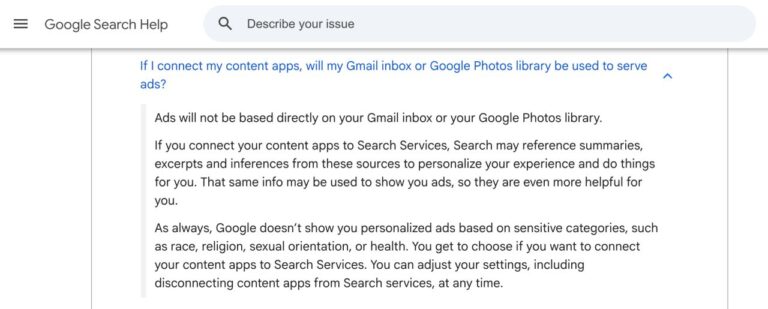
Google AI Mode now shows sponsored ads and organic products together. Found by Sachin Patel.
Test breadcrums

Sachin Patel discovered that Google tests URL breadcrumbs for sitelinks in sponsored ads
AI Summary GTM

Google Tag Manager now appears to include an AI-powered description generator for workspace updates.
When publishing changes, GTM can automatically create a description of the work completed, reducing the need to write update notes manually and making it easier to keep workspace changes documented.
The feature was spotted by Lars Friis, who noted that the next logical step would be for GTM’s AI to help create the actual updates as well.
Merchant Center

Google Merchant Center has clarified how advertisers can update product videos faster. Using a new, unique video URL triggers a fresh crawl and typically updates the video within 24–72 hours, while reusing the same URL can delay changes by up to six weeks.
Google has also added guidance on Shopping policy compliance, requiring all video assets to follow its advertising and content rules.
When a new video URL is submitted, the product may show as “Under Review” while Google processes it, with the previous video continuing to serve in the meantime.
Thanks for sharing Hana Kobzová.
Store ratings

Google has clarified its store ratings eligibility requirements for merchants. To show store ratings on paid text and Shopping ads, advertisers generally need around 100 eligible reviews, a minimum rating of 3.5 out of 5 stars, and reviews must have been collected within the past 24 months.
Ratings are also calculated separately by country, meaning reviews only contribute to the rating in the country where they originated.
The update is intended to ensure store ratings reflect a merchant’s recent service quality.Thanks for sharing Hana Kobzová.
Hover

Google is testing Sponsored Places ads that expand on hover, showing more information without a click. The test continues Google’s broader experimentation with expandable ad formats in Search.
Thanks for sharing Khushal Bherwani & Barry Schwartz.
New Guide

Google has published a new guide for lead-generation advertisers focused on preventing invalid or low-quality leads. The main message is that Google’s invalid-traffic systems alone cannot guarantee lead quality, so advertisers need their own safeguards.
Google recommends measures such as reCAPTCHA, double opt-in, server-side validation of contact details, optimization toward lead-specific conversion goals, and greater use of first-party data. It also clarified billing treatment: invalid traffic detected before month-end billing is excluded from charges, while invalid traffic found after billing results in credits on future invoices.
Thanks for sharing Hana Kobzová
Video Ads

Google Ads rolls out AI-powered Video Ads Dubbing in Asset StudioGoogle Ads has introduced Video Ads Dubbing in Asset Studio, making it easier for advertisers to localize video campaigns at scale.
The AI-powered tool can dub video ads across 33 languages and locales without requiring advertisers to reshoot the original creative for every market.
First spotted in October 2025 as an internal feature, Video Ads Dubbing is now available for free to select Google Ads users.
For advertisers running campaigns across multiple countries, this could significantly simplify video localization:
🌍 Expand existing video creative into new markets
🗣️ Dub ads into multiple languages with AI
🎬 Avoid producing separate shoots for every language⚡
Scale international video campaigns faster
The feature is available through Google Ads Asset Studio.
The update was shared by Jyll Saskin Gales & Hana Kobzová.
Heads up for anyone running Shopping in the EEA

Free listings from Google Shopping look to be disappearing in the EEA.
The space is going to price comparison services (CSS) instead.
This is part of Google’s DMA compliance after the €460M EU fine in July. Google has been reshaping Search results all month, new aggregator units for hotels, flights and products, and it already pulled the vacation-rental unit on September 8.
The compliance deadline is September 25, so expect more movement.
Credit to Gabriel Baumgarten for spotting this one.
Demand Gen
Google has clarified its ad review timelines and Demand Gen advertisers should take note.Most Google Ads reviews are still completed within 1 business day, but standard reviews for Demand Gen and Discovery campaigns can now take 3–5 business days.
For more complex ad formats, reviews may take up to 7 business days.
One important detail: editing the campaign while it’s under review can reset the clock.That includes changes to things like:
• Budgets
• Bid strategies
• Ad text
So if you’re planning a launch, it’s worth building extra review time into your campaign timeline and avoiding unnecessary edits once ads are submitted.
If the review status still hasn’t changed after 7 business days, Google says making a minor edit can restart the review process.
Update spotted by Hana Kobzová.
Expanded attributes

Google Merchant Center has expanded its product data specifications with clearer formatting guidance for its newer conversational attributes.
The update adds technical names and file-format examples, making it easier for advertisers and feed managers to submit these fields correctly across different data sources.
Key attributes with expanded documentation include:
• Document link [document_link]
• Question and answer [question_and_answer]
• Popularity rank [popularity_rank]
• Variant option [variant_option]
• Item group title [item_group_title]
Google has also published a TSV template for conversational attributes, which should make implementation and feed management more straightforward.
For advertisers working with large or complex product feeds, the added examples remove some of the guesswork around how these newer attributes should be structured.
Update spotted by Hana Kobzová.
New Metrics

Google Chrome is introducing new experimental metrics to measure how ad-heavy websites feel to users.
The metrics are being added to the Chrome User Experience Report (CrUX), which is based on real-world Chrome usage data.
Chrome will measure four new signals:
Ad Count – average number of ads visible on screen.
Ad Density – percentage of the viewport occupied by ads.
Ad Weight – Network – how much data ads consume.
Ad Weight – CPU – how much processing power ads use.
Chrome identifies ads through network filtering and analysis of ad-related scripts and frames.
Ad count and density are sampled every second, while network and CPU usage are measured over the user session.
For advertisers, the metrics could help identify cluttered or low-quality inventory where excessive advertising may hurt attention and campaign performance.
Publishers with cleaner ad experiences could potentially use the data to demonstrate higher-quality inventory.
The metrics are currently experimental, are not part of Core Web Vitals, and Google has not introduced recommended thresholds or confirmed that they will affect bidding or inventory valuation.
Updates Holiday season

Google is preparing e-commerce for the age of AI agents.Ahead of the holiday shopping season, Google is expanding its agentic commerce tools across Merchant Center, YouTube, AI Mode, and checkout.
What’s changing?
• AI performance insights now show retailers how visible their products are across AI Mode and AI Overviews.
• Business Agent is coming to YouTube ads, letting shoppers ask product questions without leaving the video experience.
• Google’s Universal Commerce Protocol (UCP) is expanding with cart transfers and improved checkout testing.
• Retailers can connect loyalty data, allowing Google to surface personalized member pricing and benefits.
• Richer product feeds and conversational attributes are becoming increasingly important for how AI recommends products.
And product data still matters.
Google says merchants following its core Merchant Center feed best practices see an average 5% increase in conversions the following month.
In testing with Lululemon, retailer-supplied conversational attributes were used in 50% of relevant AI Mode product recommendations.
OpenAI

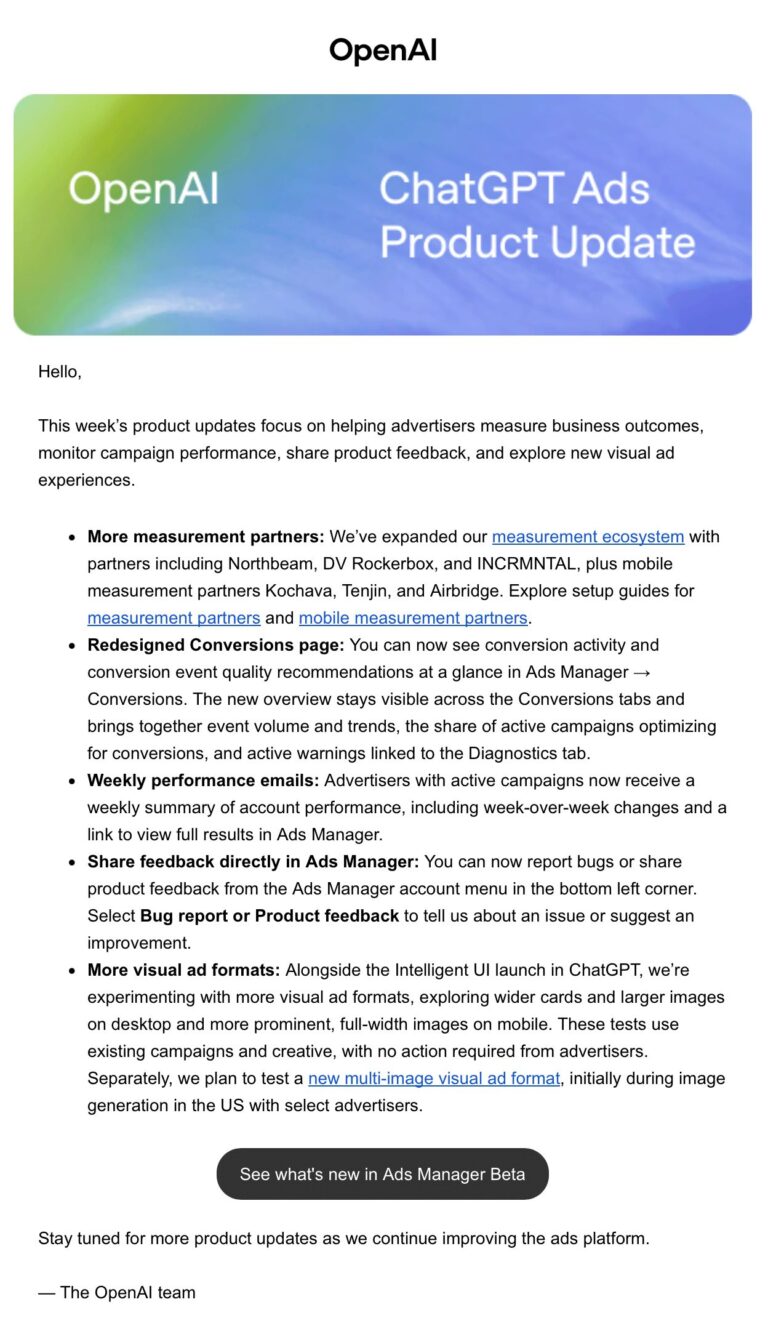
OpenAI is turning ChatGPT ads into conversations.
The company is testing Sponsored Agents clearly labeled, business-sponsored chat experiences that let users ask follow-up questions about products directly after seeing an ad.Instead of simply clicking through, users could ask about things like:
• Features
• Sizing
• Compatibility
• Product details
OpenAI is also expanding the advertiser side of the platform with AI-powered campaign creation, copy and image suggestions, conversational campaign management, and integrations with HubSpot and Shopify.
New Format

Google is testing a new ad format inside AI Mode, placing ads directly between AI-generated content. The format appears embedded within AI Mode answers, making ads feel more integrated with the surrounding content.
It differs from several other AI Mode ad formats documented recently, suggesting this is a new experiment. Google is testing the format on both mobile and desktop. The test indicates Google is continuing to experiment with how advertising and AI-generated answers can coexist within the AI Mode experience.
No details have yet been provided about advertiser eligibility, campaign setup, pricing, or performance.
Hide results

Google appears to have been testing the option to hide sponsored results within the Shopping tab. Previously, this feature was only available on the main “All” tab in Google’s SERP, but in recent days, it started appearing in the Shopping tab as well.
Thanks for sharing Sachin Patel.
Sitelink design

Google tests new sitelink design in sponsored ads, thanks for sharing Sachin Patel.
Description Ads

Google AI Mode now showing descriptions for ads, thanks for sharing Sachin Patel.
Youtube Agents

Google is testing Business Agent inside YouTube ads, allowing U.S. shoppers to ask product-related questions directly within ads instead of immediately visiting a retailer’s website.
The beta is limited to eligible Demand Gen campaigns connected to Merchant Center feeds, with a minimum $10/day budget.
It currently applies to English-language mobile in-stream ads in the U.S., while YouTube Shorts are excluded.
Google will enable the feature on qualifying existing campaigns for accepted advertisers. By default, all linked Demand Gen campaigns may be included unless specific campaigns are selected.
Business Agent builds on Google’s shopping assistant already available in Search, using product information from Merchant Center and retailer websites to answer questions such as specifications, shipping, sizing, or compatibility.
Google is also expanding AI performance insights in Merchant Center, but these reports only measure organic visibility in AI Mode and AI Overviews, not paid YouTube ads. Therefore, they cannot be used to judge Business Agent campaign performance.
Google is separately expanding its Universal Commerce Protocol checkout integrations, including cart transfers and checkout testing, but purchasing directly inside YouTube Business Agent ads is not part of this beta.
AI Label

Arpan Banerjee discovered that YouTube Shorts Ads now have an AI Label.
Benchmark

Thomas Eccel discovered that Google launched a spend benchmark report!
Prompting people to GBP

Natasha Kaurra discovered that Google is now prompting people to send people to a GBP!
New Message test

Google is testing Google Messages as a new option for Message assets in sponsored search results. Thanks for sharing Sachin Patel & Hana Kobzová.