Google Ads News
Build-to-order vehicle ads now serving in nine countries

Google’s build-to-order (BTO) vehicle ads are now serving on a limited share of traffic in nine countries: the United States, Germany, France, the Netherlands, Italy, Spain, the United Kingdom, Australia and Canada.
Key details:
Limited availability: Ads currently serve on only a small percentage of traffic in these markets.
Other regions: Advertisers can upload BTO ads, but they will not serve until the format becomes available locally.
Updated landing requirements: Ads must link to the vehicle configurator step matching the attributes submitted in the data source, rather than the initial step.
For advertisers, this opens up limited opportunities to promote customizable vehicles while bringing shoppers directly to the configuration shown in the ad.
Thanks for sharing Hana Kobzová.
AI Max experiments easier to set up in Search

Google Ads is making AI Max experiments easier to launch and customize for Search campaigns.
The updates include:
1-click setup: Eligible accounts can automatically create a 50/50 experiment through Recommendations.
Ad group controls: Advertisers can enable or disable Search term matching or Asset optimization for individual ad groups in the treatment arm.
Stable control settings: The control arm retains the base campaign settings.
Multi-campaign setup: The updated guide supports selecting multiple campaigns, with granular controls and brand settings.
For advertisers, this makes it easier to test AI Max and evaluate specific features before adopting them more broadly.
Google Ads can ask for a second document to verify your address

Google Ads can now ask for a second document to verify your address.
What Google accepts:
a second government ID showing your address
a utility, phone or internet bill from the last 60 days
a bank statement from the last 60 days
Watch out: ID photos must be taken with your phone’s own camera app. Screenshots or photos from other apps may be rejected.
For agencies: you can’t upload documents for several advertisers in one file. Each client separately, through the Ads UI.
Right now this only applies to South Sudan. But Google says more countries may follow.
My tip: check now that the name and address in your account match your bills and bank statements exactly.
An old address or a missing middle name can block verification. And without verification, your ads don’t run.
Spotted by Hana Kobzová.
#GoogleAds #PPC
Google tests ads in AI Mode with Personal Intelligence

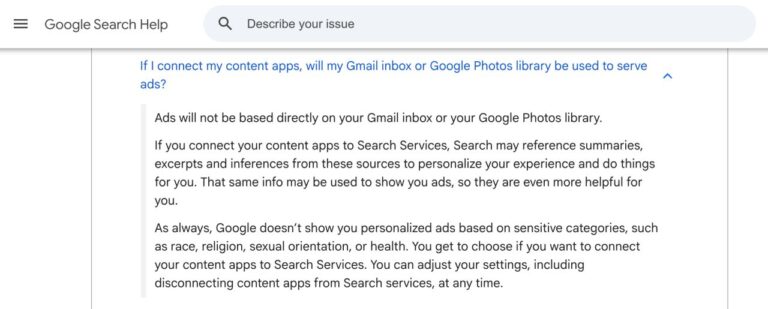
Google is testing ads in AI Mode for users who have enabled Personal Intelligence, reversing its previously ad-free approach.
Alongside search queries, AI responses and user interests, insights from connected Google apps may now help personalize ads.
Google says several safeguards remain in place:
Connecting apps is optional, and users can disconnect them anytime.
Ads will not be based directly on Gmail or Google Photos content.
Advertisers cannot access connected apps.
Sensitive information will not be used to personalize ads.
For advertisers, this could eventually offer more context for reaching relevant audiences. However, Google has not announced new targeting options, advertiser controls or a broader rollout.
Dotted underline test in sponsored results

Google appears to be testing a dotted underline on text within its sponsored search results.
Thanks for Sachin Patel .
Online gambling certification inside Google Ads

Starting October 2026, Google will incrementally allow advertisers to apply for online gambling certifications directly within their Google Ads account. This new feature will be accessible under the Admin section for affected accounts to streamline the application process.
Google Ads API v26 and two releases per month

Google Ads API v26 is here.
And Google is moving to two API releases per month.
Here’s what advertisers and developers should know:
→ Search Lift measurementAccess Search Lift studies through the API, with 15 new metrics covering incremental searches, relative search lift and impressions.
→ Local Services Performance Max
Create campaigns through the API using Google Business Profile information and the required location settings.
→ Enhanced conversions
New account-level settings provide a unified way to access enhanced conversions configuration.
→ More campaign controls
Expanded listing type support for Shopping campaigns and currency-based minimum daily budget information for Demand Gen.
→ Travel bidding updates
Standardized bid modifier fields that can be used across travel verticals. One setup detail deserves attention: the Local Services Performance Max setting must be specified when creating the campaign. It cannot be changed afterward.
Campaign Type Attribution for Demand Gen (beta)

The new feature gives Demand Gen full conversion credit within its own reporting, instead of sharing credit with Search or Performance Max.
This makes comparisons with platforms like Meta and TikTok easier but a change in attribution doesn’t mean more incremental conversions.
To use it, you’ll need:
• Data-driven attribution on all conversion actions
• Google Ads conversion tracking or GA Ads-Preferred; standard GA4 imports aren’t supported
Enable it under Goals > Settings in the account managing conversion tracking.
Spotted by Hana Kobzová.
Merchant Center expands the warranty attribute to all products

Previously limited to vehicle ads in Japan, the warranty [warranty] attribute now lets merchants specify warranty duration in months or years across product categories.
It’s optional in general, but required where local regulations mandate warranty information in ads or listings.
A small feed update worth checking if you sell in affected markets.
Details: https://lnkd.in/eSeW7u4G
Spotted by Hana Kobzová.
Sitelink test with logo

New Sitelink Test with logo spotted in Google Ads by Arpan Banerjee!
Data Strength best practices become a full implementation guide

Google has expanded its Google Ads Data Strength best practices into a detailed implementation guide, with greater emphasis on first-party data, Data Manager setup, and AI-powered campaigns.
The update specifies which identifiers advertisers should send, adds setup checklists and diagnostics, and expands guidance on tools including AI Max, Demand Gen, and Performance Max.
Google also cites performance gains, including 8% higher Search ROAS with Enhanced Conversions and 5.3% conversion uplift from Customer Match signals. These are reported results, rather than guaranteed outcomes.
Thanks for sharing Barry Schwartz.
AI Mode opens to prescription drug ads

Google Opens AI Mode to Prescription Drug Ads!
Prediction markets added to the Google Ads policies

Google added a section for prediction markets to the main Google Ads policies documentation last week.
Thanks for sharing Barry Schwartz .
Sexual content policy article updated

Google has updated the Sexual content policy article to provide additional examples and clearer information to advertisers. This does not change enforcement of the policy.
Search terms and ad combinations report for AI Max

Google Ads is rolling out a new report that provides greater transparency into how AI Max matches search queries, ad creatives, and landing pages.
Shows search terms, headlines, descriptions, and landing pages together.
Reveals whether matches and assets come from AI Max or advertiser inputs.
Helps identify irrelevant search queries and mismatched ad messaging.
Enables better optimization of negative keywords, ad assets, and campaign settings.
Limited rollout so far, with no confirmed date for wider availability.
Spotted by Natasha Kaurra .
Google Ads launches automotive model feeds (beta)

Google now allows car manufacturers (OEMs) to showcase vehicles directly in Search ads with images, prices, and features.
Available in the US, Canada, UK, and Australia.
Requires active Search campaigns and a valid vehicle model feed.
Google automatically matches vehicles to relevant searches.
Currently limited to manufacturers, not dealerships.
Thanks for sharing Hana Kobzová .
Lead Form assets: mark answers as qualifying leads

Google Ads has added an option to mark specific answers as qualifying leads when creating custom questions in Lead Form assets.
Thanks for sharing Hana Kobzová.
Budget allocation and channel prioritization controls

Google Ads is reportedly introducing Budget Allocation and Channel Prioritization controls for Performance Max, Demand Gen, Shopping, and Search campaigns.
Budget Allocation: Set maximum spending percentages for low-priority channels.
Channel Prioritization: Prioritize high-value channels before allocating remaining budget to others.
More control: Advertisers can better manage spending across Search, Display, and other channels.
Rollout: Controls are expected at both account and campaign levels.
February 2027: Search campaigns using the Display Network may need budget adjustments to prevent increased Display spending.
Thanks for sharing Thomas Eccel.
Known bug behind stuck Merchant Center video links

Arpan Banerjee received that Google confirms a known bug behind stuck Merchant Center video links
More control over Lookalike targeting in Demand Gen

Google Ads is changing how Lookalike audiences work in Demand Gen campaigns, shifting toward suggestion-based targeting by default.
Advertisers who prefer stricter audience targeting will have the option to keep the existing restrictions.
What’s changing?
Lookalike audiences will become targeting suggestions rather than strict restrictions by default.
Google’s AI will have more flexibility to reach users beyond the selected Lookalike audience.
Advertisers can opt out of this change to maintain strict Lookalike targeting.
Three audience sizes remain available:
Narrow: Top 2.5% most similar users.
Balanced: Top 5% most similar users.
Broad: Up to 10% of similar users.
What does this mean for advertisers?
Greater reach potential: Google’s AI can explore audiences beyond predefined Lookalike segments to find additional conversions.
More targeting flexibility: Advertisers can choose between AI-driven audience expansion and stricter targeting controls.
Potential impact on performance: Broader targeting may increase conversion volume but doesn’t necessarily improve conversion quality.
Importance of first-party data: Customer lists, website visitors, and other first-party audiences remain essential for building effective Lookalike segments.
Offers now shown in Shopping ads in AI Mode

Google has started showing promotions and discounts directly within Shopping ads in AI Mode.
Previously, these ads only displayed product images, names, prices, brands, and reviews.
What’s new?
Offers such as “Buy 4, get $20 off” now appear directly in Shopping ads.
Users can click on an offer to view its details in a pop-up.
This feature already exists in traditional Google Shopping results and has now been spotted in AI Mode.
AI-guided campaign creation gets a bigger spot

Google Ads has updated its campaign creation interface once again, giving AI-guided campaign creation a more prominent position.
In March, the AI-guided experience was first spotted, with the manual setup option displayed directly below it.
Now, the free-text input box takes center stage, while the manual setup option has been moved to a less prominent link labeled “Create campaign manually.”
View the updated Google Ads campaign creation interface
This change further emphasizes Googles push toward AI-assisted campaign creation while keeping manual setup available for advertisers who prefer greater control.
The update was shared by Zeeshan Ali and highlighted by Hana Kobzová.
New store_address attribute for local listings

Google has introduced a new store address (store_address) attribute, required for product submissions to Local Inventory Ads and Local Free Listings.
The attribute links products to their physical store locations and standardizes address information.
Key takeaways:
Merchants must provide a store address for applicable local product submissions.
Addresses must follow Google’s specified formatting requirements.
Merchants should review and update their local inventory feeds to ensure compliance.
Impact: Retailers using Google’s local shopping features may need to update their product feed configurations to prevent submission errors or product disapprovals.
Thanks for sharing Hana Kobzová.
A/B Test Asset group

Looks like you can now test asset groups changes 🙂 Thanks for sharing Sarah Vlietstra.
New Webinar

More and more of Google Ads is powered by AI But what should you still control as an advertiser? On Wednesday, October 21,
I’ll be hosting a webinar together with Alfred Simon & ClickPatrol™ to discuss exactly that.
We’ll dive into the growing role of AI in Google Ads and where human expertise and control still make the difference.Wednesday, October 21, 15:00 (Amsterdam time)
Can’t join live? Sign up, and you’ll receive the recording.📌
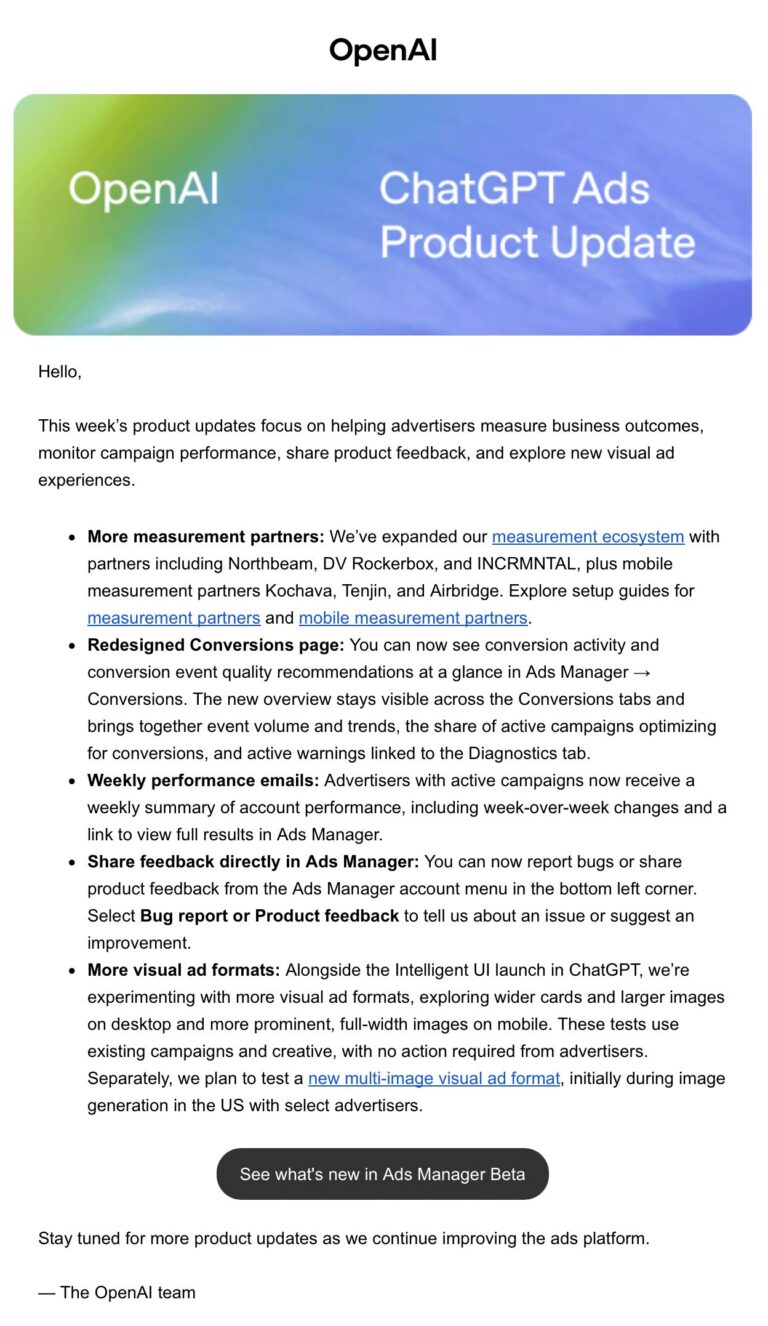
OpenAI adds measurement tools and visual formats to ChatGPT Ads

OpenAI is introducing new measurement tools and testing more visual formats for ChatGPT Ads, giving advertisers better visibility into campaign performance.
The updates include:
More measurement partners, including Northbeam, DV Rockerbox, INCRMNTAL, Kochava, Tenjin and Airbridge.
A redesigned Conversions page showing event trends, optimization status and tracking warnings.
Weekly performance emails comparing campaign results with the previous week.
In-platform feedback for reporting bugs and suggesting improvements.
Visual ad experiments, including larger images and wider cards on desktop and mobile, using existing campaign assets.
A separate multi-image format during image generation is planned for testing with selected U.S. advertisers.
For advertisers, these updates could simplify measurement and campaign monitoring while creating more room for visual creative.
The new formats remain experimental, with no performance results or broader rollout timeline announced.
ChatGPT ads now show a CTA button

ChatGPT ads are now showing a CTA button within the ad. Previously, ChatGPT showed ads without a CTA button, but today I spotted one with a dotted underline and an arrow mark.
Thanks for sharing Sachin Patel .
ChatGPT referral traffic may show up as direct traffic

Your ChatGPT referral traffic may be falling without you actually losing those visitors.
According to reporting from Search Engine Land, ChatGPT appears to have stopped adding utm_source=chatgpt.com to outbound links.
Adobe’s Cedric Huesler also reported that links were opening in a way that suppresses referral information.
If both signals are missing, analytics tools may classify those visits as direct traffic.
Huesler analyzed approximately 500 pages where ChatGPT previously accounted for at least 5% of visits.
Comparing October 9–13 with the previous week, he found:
→ Around 31,000 fewer ChatGPT visits per day.
→ Around 26,000 more direct visits per day.
→ Two-thirds of pages losing ChatGPT referrals also saw direct traffic increase.
That suggests an attribution issue.
It doesn’t prove every missing ChatGPT visit moved into direct.
The report also notes that OpenAI hasn’t confirmed whether the change was intentional.
For marketers, this is a reason to look beyond the referral report.
Check ChatGPT referrals, direct traffic, and total visits to the same landing pages together before drawing conclusions.
A drop in attributed traffic isn’t necessarily a drop in actual traffic.
And “direct” doesn’t always mean someone typed your URL.
Google Analytics User Groups Admin API

Google Analytics has introduced a new User Groups Admin API, allowing organizations to automate user group management, permissions, and account access instead of handling these tasks manually.
What’s new?
Organizations can create, update, and delete user groups programmatically.
Administrators can automatically add or remove users from groups.
Users can be assigned Member or Owner roles within groups.
Access to the API requires User Admin or Org Admin permissions.
What does this mean for advertisers and analytics teams?
More efficient access management: Automating user permissions reduces repetitive administrative work.
Better scalability: Agencies and enterprises can manage access across multiple Google Analytics accounts and properties more easily.
Improved access control: Centralized group management helps maintain consistent permissions.
Time savings: Automated workflows simplify onboarding, offboarding, and user management.
New tagging experience brings GTM and the Google tag together

Google Tag Manager is getting a major infrastructure update 🚨
Google has started rolling out a new tagging experience that brings GTM and the Google tag closer together.
The biggest change?
You’ll add Google measurement destinations directly to your GTM container.
Previously, GTM loaded an additional Google tag library to send data to those destinations. The new setup removes that extra loading step.
What this means:
→ Less JavaScript loading overhead
→ Faster measurement transmission
→ Centralized settings across the container’s destinations
→ Settings and user access managed within GTM
→ More consistent diagnostics for troubleshooting
This goes beyond a new interface. It changes how GTM connects to Google’s measurement products.
For anyone managing Google Ads and Analytics tracking, it’s an update worth understanding as the rollout progresses.
Server-side GTM containers get 7x more space

Lars Friis discovered that Server-side Google Tag Manager containers have just received 7 times more space for setups.