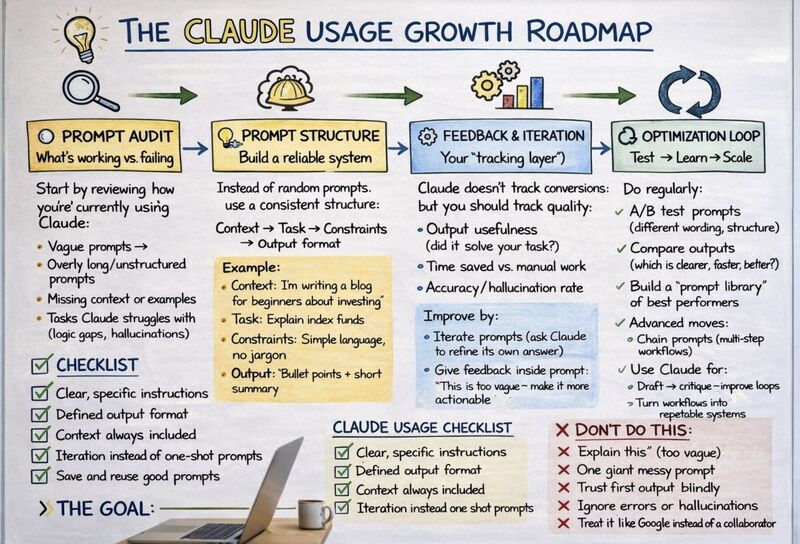
1) PROMPT AUDIT (What’s working vs. failing)
Start by reviewing how you’re currently using Claude:
Vague prompts → weak outputs
Overly long / unstructured prompts
Missing context or examples
Tasks Claude struggles with (logic gaps, hallucinations)
2) PROMPT STRUCTURE (Build a reliable system)
Instead of random prompts, use a consistent structure:
Framework:
Context → Task → Constraints → Output format
Example:
Context: I’m writing a blog for beginners about investing
Task: Explain index funds
Constraints: Simple language, no jargon
Output: Bullet points + short summary
3) FEEDBACK & ITERATION (Your “tracking layer”)
Claude doesn’t track conversions — but you should track quality:
Measure:
Output usefulness (did it solve your task?)
Time saved vs. manual work
Accuracy / hallucination rate
Improve by:
Iterating prompts (ask Claude to refine its own answer)
Giving feedback inside the prompt
“This is too vague — make it more actionable”
4) OPTIMIZATION LOOP (Test → Learn → Scale)
Do regularly:
A/B test prompts (different wording, structure)
Compare outputs (which is clearer, faster, better?)
Build a “prompt library” of best performers
Advanced:
Chain prompts (multi-step workflows)
Use Claude for:
Draft → critique → improve loops
Turn workflows into repeatable systems
CHECKLIST
Clear, specific instructions
Defined output format
Context always included
Iteration instead of one-shot prompts
Save and reuse good prompts
DON’T DO THIS
“Explain this” (too vague)
One giant messy prompt
Trust first output blindly
Ignore errors or hallucinations
Treat it like Google instead of a collaborator
THE GOAL
Better prompts → Better outputs → Faster workflows → Real leverage 🚀