Google Ads News
LSA Problem

Google Local Service Ads can be very expensive, sometimes costing hundreds of dollars per call or click. Normally, Google refunds advertisers for mistaken or invalid leads.
However, marketing expert Anthony Higman reported a case where Google charged his client $400 for a call from an existing customer who clicked the LSA ad.
Even after confirming the caller was not a new lead, Google refused to refund the charge despite multiple escalations.
Confirm Political

Arpan Banerjee just got the mail that you need to confirm whether or not your campaigns have European Union political ads | Deadline March 31, 2026!
OpenAI is exploring the next step in monetizing ChatGPT

According to reports, OpenAI has held early talks with The Trade Desk about helping sell ads on the ChatGPT platform.
The discussions suggest OpenAI may initially rely on established ad-tech partners to scale advertising across ChatGPT’s free and lower-priced tiers.
At the same time, the company reportedly plans to develop its own advertising technology in the long term.
OpenAI hits pause on in-chat shopping

OpenAI is reportedly moving e-commerce checkout out of ChatGPT and into external apps instead.
The feature launched last year allowed users to buy directly from merchants like Etsy and Shopify without leaving the chat.
Now the plan is to shift “Instant Checkout” to the Apps ecosystem, likely to reduce complexity around:
– real-time pricing & inventory updates
– fraud prevention
– merchant integrations
The move suggests AI-native shopping is still early, and scaling it safely is harder than expected.
Target only audiences

Anthony Higman discovered this unusual recommendation to target only audiences!
Customer match

Thanks to Arpan Banerjee for sharing this update with me! Google Ads has announced upcoming changes to Customer Match uploads in the Google Ads API.
Starting April 1, 2026, developers will need to use the Data Manager API instead of the Google Ads API for uploading Customer Match data.
Good reminder for teams working with Customer Match integrations to review their implementation and plan the transition early to avoid disruptions.Appreciate you flagging this, Arpan!
BIG META UPDATE

Meta is updating its ad measurement to better reflect how people interact with ads on social media and to align reporting with third-party analytics tools.
Main changes:
Click-through attribution will now count only link clicks for website and in-store conversions, improving consistency with tools like Google Analytics.
Conversions from actions like likes, shares, and saves will move to a new category called engage-through attribution (formerly engaged-view attribution).
For video ads, an engaged view is now defined as 5 seconds instead of 10 seconds, reflecting faster user behavior.
Meta is also partnering with analytics platforms like Northbeam and Triple Whale to include both views and clicks in attribution models.
Overall: These changes aim to make ad performance reporting clearer while still capturing the value of social interactions.
Subscription Policy

Physical goods subscriptions policy will be updated to formally include alcohol (for example, Wine Clubs) for eligible merchants in the United States.
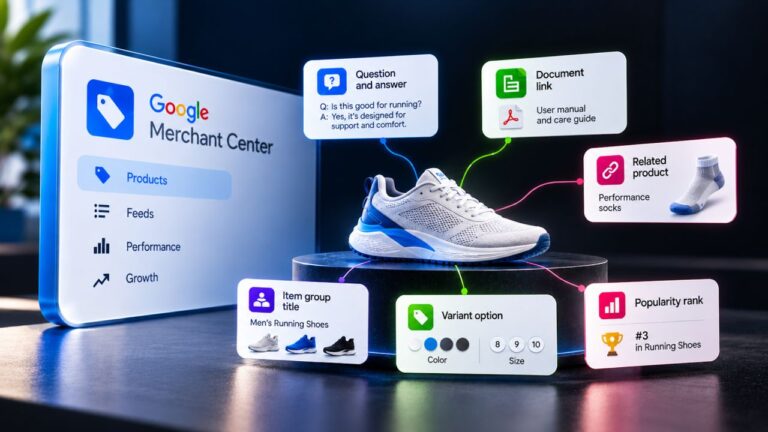
Google now strongly recommends 1500 × 1500 images for product feeds

A new, prominently placed notice on the Merchant Center “image_link” help page advises advertisers to use images near or above 1500 × 1500 pixels to ensure best performance across all listing formats including ads and free listings.
The recommendation appears at the very top of the page, highlighted to draw attention.
Why it matters: Higher-resolution images can improve visibility, eligibility across placements, and overall engagement. Smaller creatives may limit performance as formats continue to evolve.
If you’re running Shopping ads or free listings, it may be time to audit your product feed and upgrade lower-resolution images.Spotted by Hana Kobzová.
UCP

Google just published new guidance on its Universal Commerce Protocol (UCP) and how it enables AI-driven, on-Google checkout.
Key takeaway for merchants: UCP can power a native “Buy” button on Google surfaces, while you remain the seller of record.
To participate, you’ll need the native_commerce attribute in Merchant Center.Payments use stored Google Wallet credentials, and your payment processor must support Google Pay tokens. Why it matters: less checkout friction in experiences like Gemini and AI Mode, and a clearer operational playbook for implementation.
Thanks for sharing Hana Kobzová
Google is testing a new label in Search: “Sponsored options in the area.”

The new sponsored section is appearing in certain local queries and highlights nearby businesses under a clearly marked sponsored header.
In one example, law firms were shown with an image carousel directly within the sponsored block.The update was first spotted by Anthony Higman and later shared by Barry Schwartz.
Why it matters: This further blends paid placements into the local discovery experience, potentially increasing visibility for advertisers targeting high-intent, location-based searches.
Google expands recurring billing for certified U.S. online pharmacies

Certified merchants can now promote:
• Prescription drug subscriptions
• Prescription drug bundles (drug must be the primary product)
• Recurring prescription consultation services
To qualify, pharmacies must maintain certification, submit subscription pricing via the [subscription_cost] attribute in Merchant Center, clearly display terms and fees, and comply with Healthcare & Medicine and recurring billing policies.
Why it matters: This unlocks subscription-based revenue opportunities while staying compliant with Google’s advertising rules.
VRC

VRC Non-Skip ads are now globally available in Google Ads unlocking AI-optimized, non-skippable reach on YouTube CTV screens.
Google is rolling out VRC (Video Reach Campaign) Non-Skips, expanding how brands connect with audiences watching YouTube on connected TVs.
What’s happening
VRC Non-Skips are now live globally in Google Ads and Display & Video 360. The format is purpose-built for the living room experience, ensuring ads run as non-skippable placements optimized specifically for CTV screens.
Why this matters
YouTube has been the No. 1 streaming platform in the U.S. for three consecutive years. The TV screen is now prime real estate for brand budgets. With guaranteed, non-skippable delivery, advertisers can ensure their full message is seen in premium, lean-back environments.
AI in the mix
Google AI dynamically optimizes across:
• 6-second bumper ads
• 15-second standard spots
• 30-second CTV-only non-skippable formats
Instead of manually splitting budgets by format, brands can rely on AI to allocate impressions for maximum reach and efficiency.
Advertising just entered the AI conversation

Criteo is now the first ad tech partner integrating with OpenAI’s advertising pilot in ChatGPT (Free and Go, U.S.).This is a structural shift.
For years, digital advertising has lived in search results, social feeds, and display inventory. Now it’s moving into conversational interfaces where users are asking high-intent, decision-driven questions.
Data from 500 U.S. retailers shows that traffic referred from LLM platforms converts at 1.5x the rate of other referral channels.
That matters.When discovery happens inside AI, the funnel compresses. Consideration becomes contextual. Intent becomes explicit. And performance marketing enters a new surface.
Criteo managing over $4B in annual media spend integrating into this pilot signals something bigger:
– Commerce media is expanding into conversational AI
– Retail and brand demand generation is evolving
– LLM platforms are becoming performance channels.
Update Other Restricted Businesses: Government Documents and Services

Google will update its “Other Restricted Businesses: Government Documents and Services” policy on March 17, 2026.
Advertisers promoting Business Identifiers and targeting only India will not need to qualify as a government or authorized provider.
However, they must still apply for an exclusion to prevent ad disapproval. Businesses advertising other restricted government documents or services will continue to require appropriate certification under the relevant category.
The updated policy will be enforced starting March 17, 2026.
Thanks to Arpan Banerjee for sharing this update.
Build to order

Google has added a “build to order” availability option in GMC giving vehicle sellers a clearer way to list customizable, factory-order models.
Week 10 finished