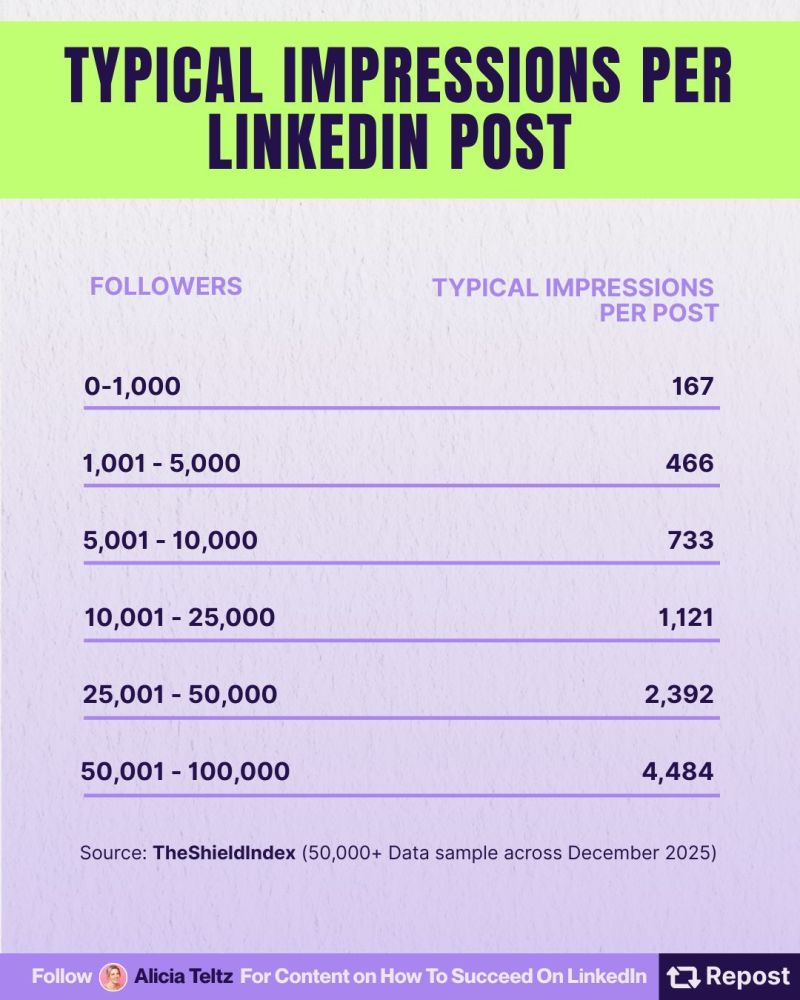
Typical Impressions per Linkedin Post
Shared by Alicia Teltz! This really shows that not every post goes viral. Be happy with your impressions and improve 1% every day!
Typical Impressions per Linkedin Post Read More »
Shared by Alicia Teltz! This really shows that not every post goes viral. Be happy with your impressions and improve 1% every day!
Typical Impressions per Linkedin Post Read More »
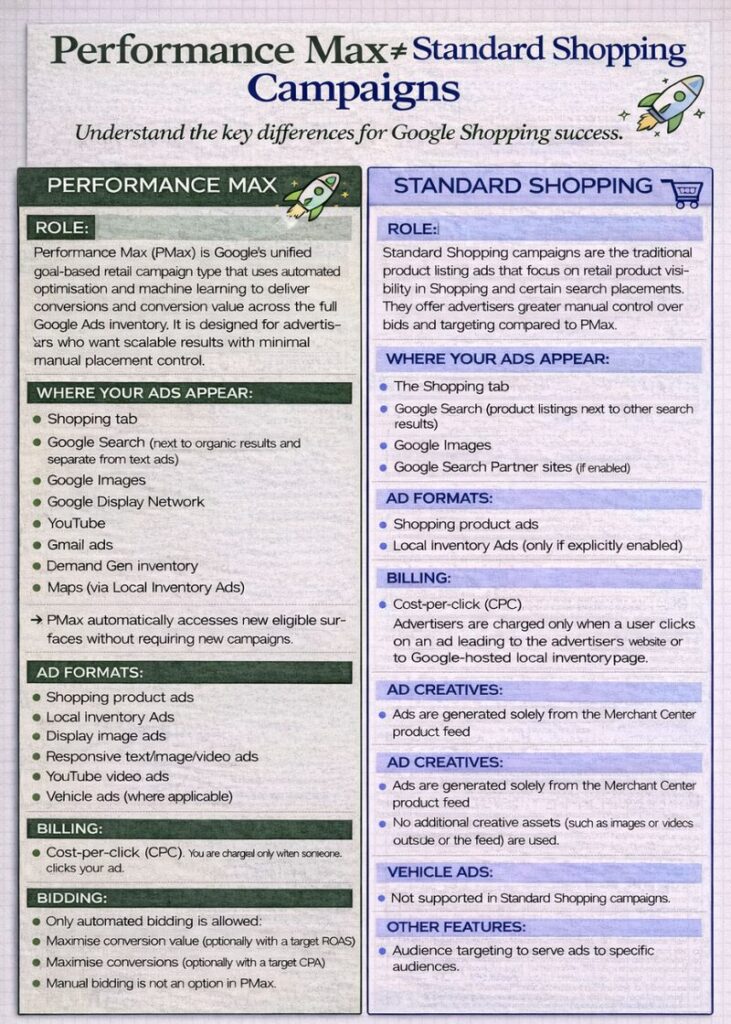
Here’s how the real PMax vs Standard Shopping setup actually works ↓ Performance Max is not a Shopping campaign with more placements.It’s a different operating model. The difference shows up in four layers: Distribution layer↳ Performance Max distributes your products across Search, Shopping, YouTube, Display, Gmail and Maps↳ Standard Shopping is limited to Shopping, Search
You can’t treat Performance Max like an upgraded version of Standard Shopping! Read More »

The exact 4-step setup I use to launch and fix Google Ads accounts for growth-focused teams and agencies. THE FOUNDATION (STRUCTURE + INTENT) → Build campaigns only when different settings are required→Structure ad groups strictly by service→ Map keywords and search intent to real business offerings→ Define funnel stage per campaign (problem-aware vs solution-aware) Outcome:
Build a profitable Google Ads system Read More »

Facebook is rolling out new creative features powered by Meta Platforms, Inc.’s AI that make it easier for people to express themselves across profile photos, Stories, Memories and Feed posts. Users can now animate their profile picture using preset effects (such as waving, confetti, party hat or hearts), turning a static photo into a short,
Facebook’s new creative features Read More »

Looker Studio Pro for Google Workspace You can now purchase a Looker Studio Pro subscription directly via the Google Workspace Admin console. This makes provisioning and license management fully centralized for Workspace admins, instead of relying on separate billing or manual access setups. Practical takeaway for teams like yours (especially if you share Looker Studio
Looker Studio updates Read More »

Google just announced 7 real updates that will reshape how ads and commerce work in 2026. Short version ↓ Based on Google’s new roadmap. AI Mode gets its own native Shopping ad formatAds appear inside the AI shopping conversation, next to AI product recommendations. AI Mode ads expand beyond retail (starting with travel)Same conversational ad
7 new Google updates Read More »

Hana Kobzová discovered that Product Eligibility Per Campaign is now Live in Products Sections!
Product Eligibility Per Campaign Now Live Read More »

Google has launched a preview of WebMCP, a new way for AI agents to interact directly with websites. Instead of guessing how a site works, AI can use structured instructions provided by the website to complete actions like booking flights, filling out forms, or making purchases. This could become a major shift for SEO and digital
Google Unveils WebMCP Read More »

Google is rolling out recommended experiments directly inside the Google Ads Experiments dashboard. Advertisers now receive preconfigured test ideas — from bidding strategies to creative variations — based on their account data. The goal: make testing faster and easier. While this lowers the barrier to experimentation and accelerates optimization, advertisers should still review setups carefully to
Recommended experiments Read More »

Microsoft has introduced a new AI Performance report inside Bing Webmaster Tools. This is the first official dashboard from a search platform that shows how your content is surfaced inside AI-powered answers, including Microsoft Copilot, AI summaries in Bing and selected partner experiences. In the new report you can see: Total citationsThe total number of
New AI Performance report Read More »

Here’s how Google’s AI Max workflow actually works ↓ AI Max is essentially a Performance Max-style upgrade for Search. But instead of optimising around keywords and ads, it optimises around intent, assets, and destinations. It’s built on four layers: Strategy & direction↳ Balance automation with control↳ Move from strict keywords to AI-driven search term matching↳
You can’t run AI Max like a normal Search campaign. Read More »

ChatGPT will show sponsored results for logged-in users on the Free and Go tiers in the US. But:• ads are clearly separated from answers• ads do not influence the generated responses• advertisers never see conversations, memory or personal data• targeting is based on the topic of the conversation and past interactions — only in aggregated
🚨ChatGPT has started testing ads inside ChatGPT🚨 Read More »

Recently i made a new YouTube video about How To Turn Your Competitors’ Brand Searches Into Your Sales With Google Ads Click on this link to acces the video!
Turn Your Competitor’s Brand Searches Into Your Sales With Google Ads Read More »

That’s the real headline. According to CNBC, OpenAI will begin testing ads inside ChatGPT this week, following internal updates shared by Sam Altman. Not a future roadmap. Not a vague experiment. This is live testing — now. Why this matters: ChatGPT is no longer just an AI product. It is becoming a monetised interface for
ChatGPT will start testing ads this week. Read More »

Google confirms delays in Google Ads API developer token reviews due to high demand following the launch of Explorer Access and new API tools. Extra reviewers have been added and some applications are being fast-tracked. Advertisers and developers are advised to stay on Explorer Access unless they are hitting quotas, missing features, or clearly planning
Google Ads API developer token Delays Read More »
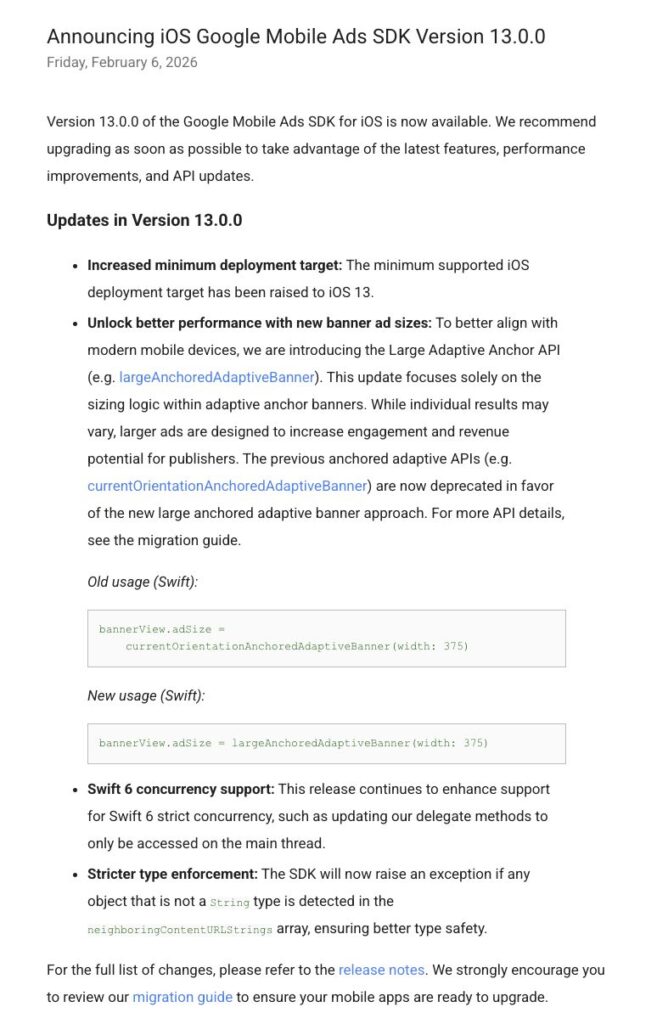
Google has released Google Mobile Ads SDK for iOS v13.0.0, raising the minimum iOS target to iOS 13 and introducing the new large anchored adaptive banner API for improved banner performance. Older anchored banner APIs are deprecated, Swift 6 concurrency support is improved, and stricter type checks are enforced. SDK 11.x is now deprecated and
Google Mobile Ads SDK Version 13.0.0 Read More »

Google Tag Manager now sends a wider range of Google Ads website events automatically, reducing the need for manual event configuration and improving overall data consistency. According to Google, advertisers may see additional network requests to Google domains as more events are collected and transmitted in the background.
Improved website event data collection Read More »

Google Ads has renamed the YouTube campaign objective group from “Awareness and consideration” to “YouTube reach, views, and engagements”. Thanks for sharing Aditya shrivastava.
YouTube reach, views, and engagements Read More »
When I started this Google Ads newsletter, the goal wasn’t “grow a list”. It was simple: make sense of everything that’s changing in Google Ads and turn updates into actual decisions you can use as a PPC specialist. Seeing it reach 115k now is honestly a bit surreal. Huge thanks to everyone who reads, replies,
115,000 subscribers Read More »
Signs ChatGPT Ads: https://lnkd.in/eK4RRFeuNew diagnostics: https://lnkd.in/e9m4qefPNew Beta Type: https://lnkd.in/eT-5vXHFNew approval: https://lnkd.in/epKx95XdMore Malicious Google Ads: https://lnkd.in/euH63zizAlphabet revenue: https://lnkd.in/eZi5JAJvGMC: https://lnkd.in/e63fYXSsCall ads: https://lnkd.in/edNwbmhWPmax update: https://lnkd.in/erw3y2eVPolicy update: https://lnkd.in/e4UtHBrV
Google Ads Newsletter – Week 6 Sponsored by ProfitMetrics.io Read More »
Google Ads News Policy update Starting February 5, 2026, Google no longer allows personalized targeting for App campaigns promoting Rummy and Daily Fantasy Sports apps in India. Only non-personalized delivery is permitted for this vertical in that market. Big Pmax Update Matteo Braghetta discovered that Google is rolling out controlled A/B testing for creatives directly
Google Ads news – week 6 Read More »

Starting February 5, 2026, Google no longer allows personalized targeting for App campaigns promoting Rummy and Daily Fantasy Sports apps in India. Only non-personalized delivery is permitted for this vertical in that market.
India Ends Personalized Ads for Rummy & DFS Apps Read More »

Getting help is a cheat code. I came in thinking I would mainly learn how to punch harder. What I actually learned was how much faster you grow when someone is watching you closely. Tiny details: – foot position– timing– when to relax instead of forcing power Things I would never have noticed on my
One unexpected lesson I learned from PT boxing Read More »

The PPC community is genuinely one of the most supportive communities I’ve ever been part of. Not competitive in a toxic way. Not hiding knowledge. Not afraid to say “I tested this and it failed”. Instead, people openly share: – experiments that didn’t work– scripts and workflows that save hours– honest opinions about new Google
One thing I keep noticing in this industry Read More »

Matteo Braghetta discovered that Google is rolling out controlled A/B testing for creatives directly inside Performance Max!
🚨Big Pmax Update 🚨 Read More »

In a quiet corner of the tech newsroom, Google unveiled a confident message: Gemini was finally closing the gap with ChatGPT. The headline numbers looked impressive, and for a moment the room buzzed with talk of a turning point. But when the editors compared how those users were actually counted, the excitement softened. Gemini’s audience
Gemini was finally closing the gap with ChatGPT. Read More »

Today, I uploaded a new video on my YouTube channel where I discussed the three major mistakes in Google Ads that quietly destroy your ecommerce profit. For more information about this topic, click the link to watch the video!
3 Google Ads mistakes that quietly destroy ecommerce profit Read More »

Recently, I made a YouTube video where I discussed how to stop wasting money on Meta ads. For more information about this topic, click the link!
Stop wasting money on Meta Ads Read More »

DATA EXCLUSIONS! With this feature, you can exclude any of your Website Visitor Lists OR Customer Match Lists! This will seemingly exclude all remarketing lists (it’s not just an audience signal). Spotted by Callie Kessler
🚨BIGGEST UPDATE IN PMAX (LAST WEEK)🚨 Read More »

Google Merchant Center is now surfacing recommendations specifically aimed at improving your product description field in the feed. The idea is to push advertisers to use richer, more descriptive and query-aligned product text so Google can better understand, match, and rank products across Shopping and Performance Max placements. For advertisers, this means feed optimisation is
Surfacing Recommendations in Google Merchant Center Read More »

Alphabet delivered a very strong Q4 and closed 2025 with several structurally important signals for the ads and AI ecosystem. Annual revenue passed $400B for the first time, with FY revenue up 15% YoY and Q4 revenue up 18% YoY. Operating income also continued to scale, reaching $129.0B for FY 2025 (+15% YoY) while keeping
Alphabet reaches 400 billion revenue 🚨 Read More »

More Malicious Google Ads are targeting Mac users by posing as legitimate tools (for example “Mac cleaner”) and then redirecting them to fake Apple-style support pages hosted on trusted Google domains. These pages instruct users to run hidden Terminal commands, which can compromise the system. The campaigns appear to use hijacked, previously legitimate advertiser accounts,
Malicious Google Ads Target Mac Users Read More »

Google Ads now has a “Multi-Party Approval” security feature: sensitive admin changes (like adding/removing users or changing roles) will require a second administrator’s approval before they go through. If another admin doesn’t approve or deny the request within ~20 days, the change is blocked. This helps prevent account hijacking by making it harder for a
Multi-Party Approval Read More »

Emil Emanuel Ankjær Nordahl discovered that Mixed campaign type experiments are now available in an early beta. You can test different campaign types against each other (for example Search vs. Performance Max, Demand Gen vs. video, or feed-only PMax vs. Standard Shopping). The main limitation is that both campaigns must already exist, so you can’t
Mixed type experiment in early beta Read More »

Glenn Gabe & Barry Schwartz have spotted references to “ads shown to the user” in the source code of ChatGPT responses, even though live ads aren’t widely visible yet. This reinforces OpenAI’s recently announced plan to begin testing ads in the free and lower-cost Go tier, with ads clearly separated from answers and not influencing

Animated images Thomas Eccel discovered that Google now lets you animate product images or any other image with AI directly inside Merchant Center. Creator Partnership section Thomas Eccel discovered that two new Creator Partnerships sections:Creator Search: keyword search + filters (subs, views, location, contact options)Management Menu: manage creator inquiries in one clear overview E-barometer Update
Google Ads news – January Recap Read More »

Google Ads News New Partner program Google has rolled out a refreshed Google Partners Rewards website with a cleaner design and improved navigation, making it easier for partners to understand rewards and track progress. The update is rolling out gradually, so not everyone will see it yet. Spotted by Anthony Higman & Hana Kobzová. Logo
Google Ads news – week 5 Read More »

Google is testing a new feature in Search ads that shows third-party endorsement content alongside the ad. In this experiment, ads may include a third-party site’s name, logo, and a short endorsement line below the main ad text for example, a reviewer rating like “Best for Frequent Travelers” from PCMag. Google has confirmed the test
Google Tests Third-Party Content in Search Ads Read More »
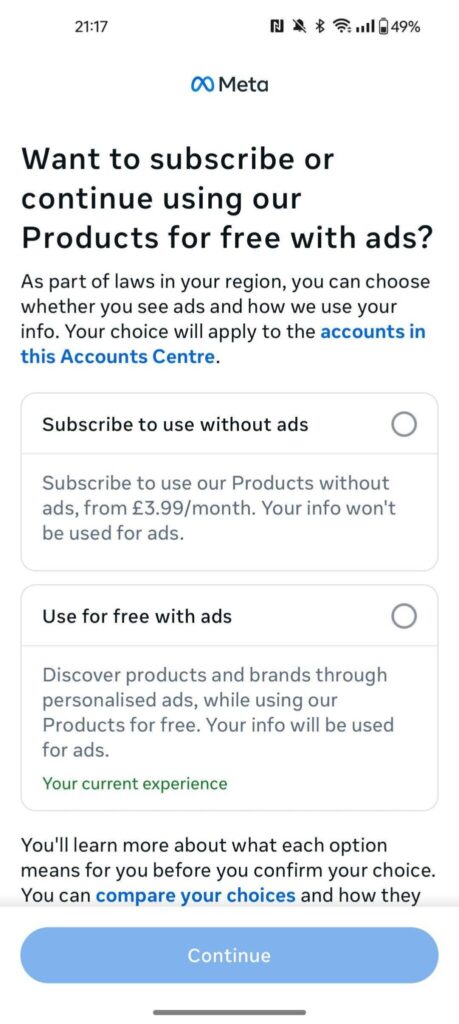
Meta is testing paid subscription options across Instagram, Facebook and WhatsApp, offering premium features and expanded AI tools while keeping the core apps free. Early tests on Instagram may include features like unlimited audience lists, insights into non-followers, and the ability to view Stories without notifying the poster. Meta also plans to offer paid access
Meta Tests Paid Subscriptions Read More »

The European Commission has started new proceedings under the Digital Markets Act to assess how Google shares access to important search data and Android AI capabilities with competitors. Depending on the outcome, Google may have to open up more of the data and tools that currently strengthen its position in search and AI. This could
EU Reviews Google’s AI and Search Data Practices Read More »
Google has released version 23 of the Google Ads API, marking the first update of 2026 and beginning a faster release cycle for improvements. The v23 update brings more detailed reporting for Performance Max campaigns, enhanced invoicing data, more precise scheduling options, new audience dimensions powered by AI, and expanded campaign controls, giving advertisers and
What’s New in Google Ads API v23 Read More »

Hana Kobzová & Bia Camargo discovered that Google now has one click previews for Pmax
Easy Pmax Ads Preview Read More »

That’s the number. That’s what OpenAI is reportedly planning to charge for ads inside ChatGPT. To put that plainly: It’s significantly higher than most major social platforms. And it’s not paired with advanced measurement. Early advertisers are expected to get: – Views.– Clicks. That’s it. No detailed conversion data. No deep attribution. Limited insight into
$60 per 1,000 impressions Read More »

Thomas Eccel discovered that data manager can now suggest connections!
Suggest connections Read More »
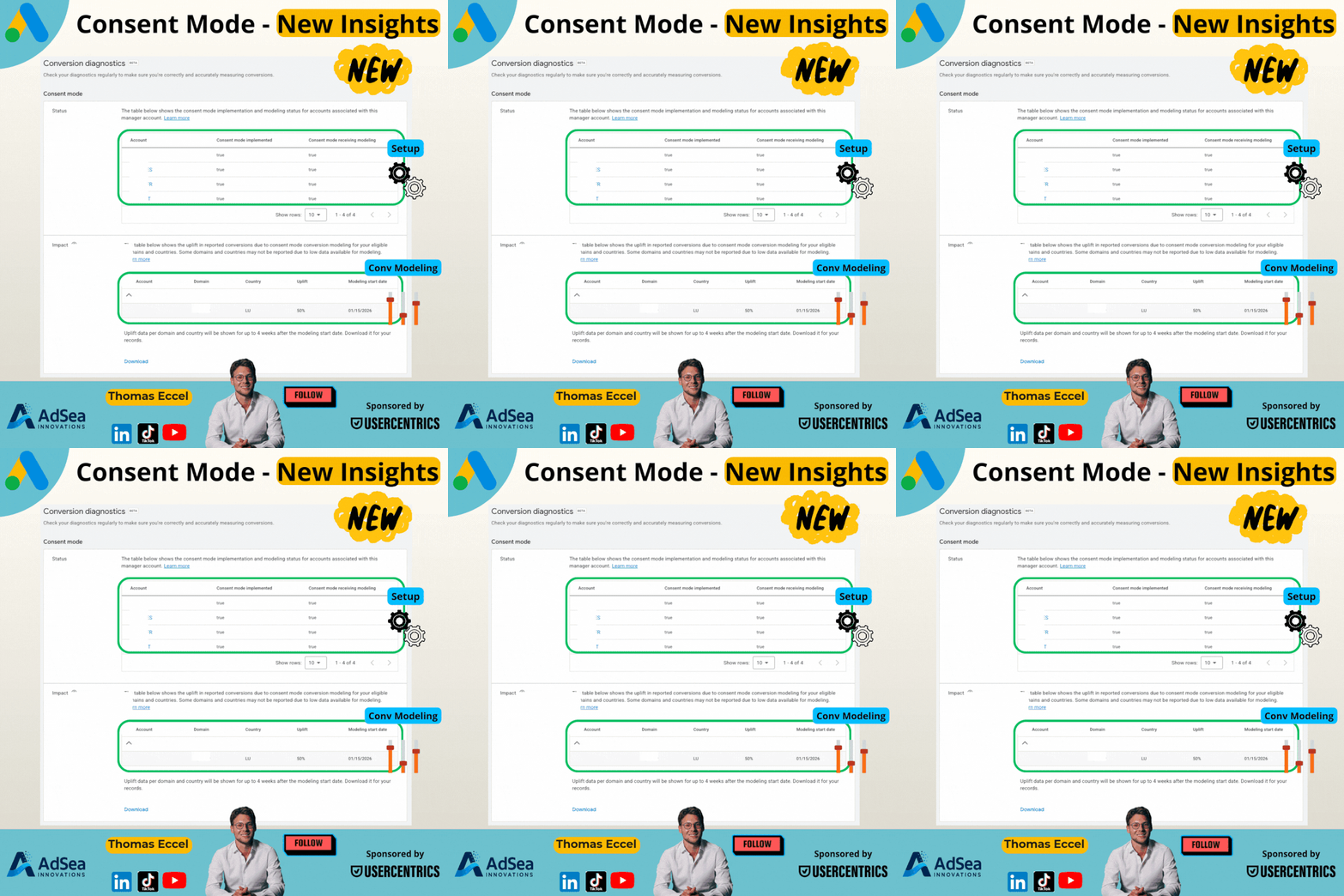
Google added new insights to Conversion Diagnostics, showing whether Consent Mode is correctly implemented and when conversion modeling actually starts. Advertisers can now see the real uplift from consent-based modeling, sometimes 50%+. That uplift doesn’t mean campaigns suddenly improved it reveals conversions that were previously invisible. As a result, historical CPA, ROAS, and CVR benchmarks
New Consent Mode Insights Read More »

Merchant Center for Agencies is now in pilot, and agencies can express interest in participating by submitting the signup form: https://lnkd.in/eJqE9dwu
Merchant Center for Agencies Read More »

Too many professionals miss connection, energy, and inspiration when working remotely. The right environment and the right people around you make all the difference. You2Lize helps you find inspiring workspaces where you can connect, belong, and work better. Don’t work alone. Work inspired. Download the app now: https://qrkit.co/WBA-1m
Remote work shouldn’t mean working alone Read More »

I came across this Visual Capitalist chart, and it puts things in perspective.ChatGPT is growing fast. But when it comes to global search behavior, Google remains in a league of its own. So what does this mean for marketers, advertisers, and AI users? Let’s break it down. Google is still the default For now, most
ChatGPT gets 1 billion daily queries. But Google? Still at 13 billion Read More »

Besides using keyword insertion for headlines you can also use it in your description or display URL.
