Animated images

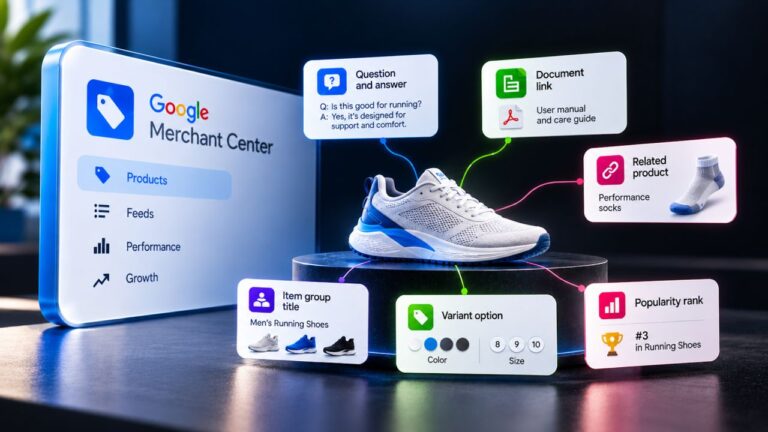
Thomas Eccel discovered that Google now lets you animate product images or any other image with AI directly inside Merchant Center.
Creator Partnership section

Thomas Eccel discovered that two new Creator Partnerships sections:Creator Search: keyword search + filters (subs, views, location, contact options)Management Menu: manage creator inquiries in one clear overview
E-barometer Update – December Report Is Live

After the Black Week peak, momentum slowed exactly as expected. What’s more interesting is the year-over-year picture.
Gross profit grew +13.0% YoY, outperforming turnover. That’s a strong signal of improving underlying profitability.
This happened despite:
– Ad spend increasing +14.6% – ROAS coming under pressure as a result. In short: margins are holding up better than topline growth, even in a more competitive ad environment.
In the full December report, we break down:
– What’s driving the profit growth – How paid media efficiency is evolving – The key trends to watch heading into 2026. Read the full report here.
Guide me

Arpan Banerjee discovered that Google gives him now the “guide me” option for disapproved ads! When he clicks on it it opens the chatbox.
Call Ads

Arpan Banerjee just sent me the reminder: Google is phasing out call-only ads.• New call-only ads stop in Feb 2026• Existing call-only ads stop serving in Feb 2027
They’ll be replaced by Responsive Search Ads with call assets.
Advertisers should start migrating now to test performance, fix tracking, and adapt messaging for both calls and clicks.
Google Ads update: Prediction Markets (Jan 21, 2026)

Arpan Banerjee just sent me that Google will allow ads for Prediction Markets in the US starting January 21, 2026 but only for federally regulated entities.
Eligible advertisers must be:CFTC-authorized Designated Contract Markets (DCMs), orNFA-authorized brokerages offering access to eligible DCM products.
All advertisers must apply for Google certification and comply with all financial regulations and Google Ads policies.For most advertisers, nothing changes. For regulated platforms, this opens a narrow but official path to paid search visibility.
Merchant Center Change

Starting March 2026, Google Merchant Center will require retailers to use separate product IDs for online and in-store versions of the same product when they differ in price, availability, or other attributes.
Online product data will become the default, and any differing in-store version must be managed as a separate product in the feed. Google is already notifying affected advertisers.
The change improves data consistency across channels but increases feed management complexity, especially for retailers using Local Inventory Ads or managing large, multi-channel inventories.
Thanks for spotting Hana Kobzová
Google Tag Gateway

Google Tag Gateway is starting to roll out a beta Google Cloud Platform integration that allows deployment with essentially one click.
The setup uses an External Application Load Balancer to route tag traffic through a first-party (same-site, same-origin) host, improving resilience against tracking prevention and ad blockers like Apple ITP.
Until now, Cloudflare was the only automated option, with other CDNs requiring manual configuration.
This new Google Cloud Platform integration lowers friction for teams already on GCP, and it’s a notable step toward broader, easier adoption of Google Tag Gateway—assuming Google follows up with solid documentation as the beta expands.
Call Ads

Thomas Eccel discovered that Google Ads is now showing Call Assets directly inside Vehicle Ads!
GEMINI IS TAKING OVER THE AI INTERNET

The first Global AI Tracker of 2026 just dropped and the shift is massive.Gemini has exploded from 5.7% to 21.5% of global Gen AI website traffic in just 12 months.
It blew past the 20% mark and became the first real threat to ChatGPT’s dominance.
Meanwhile…ChatGPT just fell from 86.7% → 64.5% in one year.Still #1 — but no longer untouchable.The gap is closing fast.
Gmail

AI Overviews are now in Gmail😂
API update

Starting on February 2, 2026, the Google Ads API will no longer accept new adopters of session attributes or IP address data as part of conversion imports.
To ensure a more robust and scalable experience for handling complex data, we recommend that Google Ads API developers transition to the Data Manager API – where session attributes and IP address are accepted – as their primary conversion and user data import API.
A/B Test

Dario Zannoni discovered that Google is rolling out a new experiment type for Performance Max campaigns: A/B testing of assets!
Belarus

On January 22, 2026, Google Ads will update its Gambling and games policy for Belarus.
Google will begin accepting online gambling advertisements in Belarus from operators with appropriate licences from the relevant authorizing body in Belarus.
Update Personalized

Google has updated the Google Ads Personalized Advertising policy for improved organization, clarity and readability.
This update, published January 7, 2026, is administrative only and does not change the substance or the enforcement of the Personalized Advertising policy.
India

On January 21, 2026, Google Ads will update the India country specifics of its Gambling and games policy to ensure compliance with local legal requirements.This updated policy will disallow all Rummy and Daily Fantasy Sports promotions targeting India.
Missing Tag

Google Ads is now displaying a new warning when the Google Tag is not installed, found by Paul Cox.
🚨 BREAKING NEWS CHATGPT LAUNCHES ADS 🚨

OpenAI will start testing ads in the US in the coming weeks, only for:
– Free tier users
– ChatGPT Go usersPlus, Pro, Business and Enterprise stay fully ad-free.
How the ads will work:
– Ads will never change or influence ChatGPT’s answers
– Organic answers come first; ads appear separately at the bottom
– Ads will always be clearly labeled as sponsored
– You can dismiss ads and say why
– You can turn off ad personalization
– Your conversations are private and never sold to advertisers
Who won’t see ads:
– Users under 18
– Conversations about sensitive topics like health, mental health, or politics
What ads will look like at first:
– Simple sponsored product or service suggestions
– Only when relevant to your current conversation
– Placed after the main answer, not inside it
Why they’re doing it:
Ads help keep ChatGPT free and affordable, so more people can use advanced AI without paying or by paying much less.
The idea is to grow access without turning ChatGPT into an ad-driven product that sacrifices trust.
Principles from OpenAI:

Policy change

Google has extended the Canada Cannabis Pilot Program. Originally announced in August 2025, the pilot will now run until December 31, 2026.
The program allows limited, legally permitted cannabis-related ads on Search in Canada only. It’s restricted to federally licensed advertisers or authorized government operators and is meant to test user interest and guide future policy updates.
The change was confirmed on January 15, 2026.
New page – Enhanced Conversions for Leads checklist

Google has launched a new page with a practical checklist to help you implement Enhanced Conversions for Leads the right way, so Google Ads can better match clicks to real lead outcomes and improve Smart Bidding.
The page covers:
Google Ads setup: accept data terms, enable auto-tagging, create unique lead conversion actions, start them as secondary.
Website tagging: use Google tag or GTM on all lead pages, enable user-provided data, capture email/phone, send hashed data.
Data prep: normalise and hash PII with SHA-256, format phone numbers correctly.Imports: upload daily via Data Manager, CRM or API, include GCLID + PII, send all conversions.
Verification: test tags, check Diagnostics, confirm conversions show in reports.Optimisation: once stable, use the new conversions for Smart Bidding.Team: make sure dev support and clear ownership are in place.
Thanks for sharing Hana Kobzová.
Campaign budget

Campaign total budgets are now in open beta for Search, Performance Max, and Shopping campaigns. Instead of managing daily budgets, you can set a fixed total budget for a specific period, from a few days to a few weeks.
This helps you control spend more precisely for short tests or timed campaigns, ensuring you don’t overspend or underspend during the activation window.
New AI Format

Google is testing a new ad format in AI Mode results: Explore-style ads that promote guides and articles, not just direct product or offer ads.
The format was spotted by Glenn Gabe, who shared an example showing an ad for informational content appearing inside AI Mode responses.
This could become one of the few reliable ways for publishers to get traffic from AI Mode, since organic links in these results appear to get limited clicks
.Reported by Barry Schwartz, spotted by Glenn Gabe.
API Change

Google is transitioning everyone from the older Content API for Shopping to the new Merchant API, which will be the main way to programmatically manage your Merchant Center data
.The Merchant API is more modern and modular, letting you automate product uploads, inventory updates, promotions, and other Merchant Center tasks more efficiently.
There are firm migration deadlines: developers currently using the Merchant API beta must complete their transition by late February 2026, and all Content API users need to switch over by mid-August 2026.
After those dates, the old Content API will stop working.If your systems, apps, or custom scripts still rely on the Content API, you’ll want to update them to use the Merchant API to avoid disruptions to product feeds and Shopping campaign management.
Thanks for sharing Emmanuel Flossie.
For more information check his video
Marketing objective?

Md Alimul Islam discovered that Google is removing marketing objectives from the campaign setting in Search Ads (like PMax).
Data control

Google Ads is adding a new layer of privacy control called Data Transmission Control, which lets advertisers fine-tune what data is sent when user consent is limited.
It works on top of Advanced Consent Mode and allows separate control over advertising data, behavioral analytics, and diagnostic data.
For example, when ad consent is denied, advertisers can choose to send limited ad data with identifiers removed (still allowing conversion modeling) or block ad data completely.
The setting lives in Data Manager under Google Tag settings and only works if Consent Mode is already active. Once consent is granted, normal data flow resumes.
First spotted and shared by Thomas Eccel.
YouTube upgrade tool

YouTube has upgraded its Promotions tool to support interest-based targeting, letting creators reach viewers based on what they care about—not just age, gender, or location.Interests are built from aggregated, anonymized signals like search behavior and viewing habits.
This makes paid promotions more precise and more comparable to traditional Google Ads targeting.The feature is currently desktop-only, with mobile expected later.First spotted and shared by Georgi Zayakov.
New LSA Test

Google is testing a new LSA change that shows different “trust” qualifiers on profiles, like “Passed license check,” “Number of recent bookings,” “Passed background check,” and “Has business insurance.”The problem is that everyone in LSA already passed all these requirements.
Google is just rotating which badges show on which profiles to test what users respond to. That means visibility and performance can change based on random test variants, not actual differences between advertisers.
This kind of large-scale testing directly impacts advertiser results, turning everyone into test subjects. It’s especially frustrating when the tested elements don’t reflect real differentiation, since all advertisers had to meet the same standards just to be eligible.
Found by Anthony Higman
New LSA Test

LSA has new updates: Google seems to have dropped the test that limited users from seeing the full 20-pack. The “Less Personal Injury Lawyers” button (which pushed people into only the 2-pack or 8-pack) appears to be gone, meaning users can again view the full list of profiles. Great news for visibility.
Found by Anthony Higman
LSA Banner

Google just Updated The Banner In LSA Accounts. Found by Anthony Higman.
Google Ads has made Manual CPC easier to find during campaign setup

The option now appears directly under the “Conversions” goal as “Manually set bids,” instead of being hidden behind the “not recommended” flow.
This makes it quicker for advertisers who prefer Manual CPC to choose it without extra steps.
Observed by Hana Kobzová.
Shop Update

Google has updated Shopping Promotions with new features and policy changes that make discounts more flexible especially for subscription businesses.
The biggest change is support for subscription-based promotions. Merchants can now run deals like money off, percentage discounts, or free trials specifically for subscription products, helping attract new customers and boost sign-ups.
Google also now allows common promo abbreviations like BOGO, B1G1, MSRP, and MRP in promotion titles, making offers clearer and more recognizable to shoppers.
In some markets, promotions can now be tied to specific payment methods, opening the door to cashback or wallet-based deals.
Overall, the update makes Shopping promotions more powerful, more flexible, and better suited for subscription and deal-driven businesses.
This update was found by Emmanuel Flossie for his video check this link.
Account-level placement exclusions

Google Ads now allows account-level placement exclusions, so advertisers can block unwanted websites and apps across all campaigns at once.
Instead of setting exclusions per ad group or campaign, one list can now apply to Performance Max, Demand Gen, YouTube, and Display campaigns, making brand-safety and quality control much easier.
Observed by Aleksejus Podpruginas & Hana Kobzová.
Conversion Summary

Google Ads has added a conversion summary to the Ads Advisor panel under performance graphs. Advertisers now see a quick recap like total conversions and top campaigns—before the AI-suggested questions.
This builds on the December 2025 update that added inline AI prompts, and continues Google’s shift toward AI-assisted analysis inside the main campaign view.
Observed by Hana Kobzová.
A/B Test shopping titles!

Duane Brown discovered that product title experiments are live for some advertisers!
Apple and Google just announced a major multi-year partnership

Google’s Gemini will become the foundation for Apple’s next-gen AI models and cloud stack.
Apple says Gemini offers “the most capable foundation” for its Apple Foundation Models and it will unlock new intelligent experiences across Apple products.
What does this mean?• Gemini will help power Apple Intelligence
• Siri will become far more personalized
• Smarter, more context-aware iPhones coming this year
Two tech giants are teaming up to shape the future of AI on your phone.iPhones are about to get a lot smarter.
Business Agent live

Google has launched Business Agent, an AI-powered virtual associate that lives directly on a brand’s Google Search Business Profile. Built on Gemini models, it can answer detailed customer questions in the brand’s own tone, using data from the website and Merchant Center going far beyond basic store info.
The full “Business Agent” experience, including customization and advanced features, is currently only available to US businesses.
More basic conversational features expanded in 2025 to Canada, Australia, and India, but the advanced version is US-only for now.
Merchants can set it up in Google Merchant Center under the Marketing section by customizing the welcome message, conversation starters, appearance, and support handoff, then activating the agent.
For brands, the value is clear: 24/7 support during buying moments, deeper answers than standard product feeds, and upcoming features like performance insights and agentic checkout for in-chat purchases.
To qualify, a business must be US-based, have a verified Merchant Center account, at least 50 approved offers, and a claimed brand profile.
Thanks for sharing Aleksejus Podpruginas
Update

Google updated the terms for Call and Messaging Ads, and they’re much stricter now:Google will record basically everything that happens through these ads: phone calls, texts, chats, and other communications.
If you accept these terms, you not Google are responsible for telling everyone involved:-
Your employees, contractors, and vendors- Your clients- And making sure your clients tell their own staff. You must get express consent, not just implied consent.
Google and its partners can monitor and use these recordings, including for things like training systems (very likely AI-related).If there’s a legal problem, the liability is on the advertiser, not Google even though Google is doing the recording.
By accepting, you also confirm you are not subject to HIPAA.
These terms are not HIPAA-compliant. If you deal with medical data, you should not accept and should contact Google instead.
In short: more recording, more responsibility on advertisers, more risk, and not safe for HIPAA-regulated businesses.
Thanks for sharing Anthony Higman!
Create account

New option found by Anthony Higman: “Create An Account With Campaign For Faster Set Up” In Account Creation In An MCC.
15 videos

Google is testing a bigger video asset limit in Performance Max, allowing up to 15 videos per asset group instead of the usual 5.
That means advertisers could include more creative variations and cover multiple video ratios in one place, reducing the need for duplicate asset groups or fragmented setups while improving coverage across placements.
This change reflects Google’s growing emphasis on video-rich PMax creative sets and gives advertisers more flexibility in how they layer video into their automated campaigns.
This change was found by Molly Pritchard and Hana Kobzová!
LSA Change

Google Local Ads are prioritizing clickable assets over traditional text with examples showing units featuring up to 9 distinct links (call, website, directions, sitelinks) and much less emphasis on headlines/descriptions.
This signals a shift toward multi-link engagement and interaction-driven formats in local search ads, where users can act immediately rather than read copy.
With more clickable options front and center, local advertisers should rethink how they structure and optimize asset sets to drive action.
Thanks for sharing Anthony Higman
Live sports bidding

Google just made premium live sports inventory including the Olympics available as biddable Connected TV.Instead of only buying via upfront deals, advertisers can now access live sports through Display & Video 360 as programmatic CTV.
That means:
• Buying Olympic and live sports inventory like any other biddable media
• Using Google audience data on big-screen TV
• Managing frequency across TV, YouTube and other devices
• Measuring impact beyond impressions, down to real outcomesLive sports = massive attention.
Now it also comes with performance-style control.
Retail just entered a new phase

On January 11, 2026, Google announced a major shift toward “agentic commerce,” a world where AI doesn’t just help people shop, but increasingly shops on their behalf.
This isn’t a concept anymore. It’s being rolled out.
Here’s what changed:
First, a new open standard for agentic commerce The Universal Commerce Protocol (UCP) creates one shared language for AI agents, platforms and payment systems from discovery to checkout to support.
It’s backed by names like Shopify, Walmart, Target, Etsy, Wayfair, Stripe, Visa and more.
Second, checkout inside AI Shoppers can now buy from eligible retailers directly inside Google’s AI Mode and the Gemini app using saved Wallet data.
Fewer steps. Less friction. Fewer abandoned carts.
Third, branded AI sales agents Retailers can launch a “Business Agent” in Search a branded AI that answers product questions and helps close sales in real time.
Fourth, product data built for conversation Merchant Center is adding new attributes focused on how people and AI actually ask questions:
– Common product questions
– Compatible accessories
– Substitutes and alternatives
Fifth, deals at the moment of decision Google Ads is testing “Direct Offers” exclusive discounts that appear inside AI Mode when someone is ready to buy.
What this means: Shopping is no longer just human-driven. AI is becoming an active buyer.
Retailers now have two audiences: People. And the agents acting for them. Discovery, persuasion, and checkout are moving into AI interfaces. If your data isn’t readable by machines, you won’t be chosen by them.
This is what the next era of retail looks like.
🚨BIG UPDATE IN PMAX🚨

DATA EXCLUSIONS!With this feature, you can exclude any of your Website Visitor Lists OR Customer Match Lists!This will seemingly exclude all remarketing lists (it’s not just an audience signal).
Spotted by Callie Kessler
Demand Gen January Updates

January Demand Gen updates – key takeaways
Demand Gen is rolling out several features into general availability that were previously previewed, expanding its role as a full-funnel discovery and conversion channel.
Shoppable CTV is now powered by Demand Gen
Advertisers can enable interactive shopping experiences on YouTube TV screens, allowing viewers to browse and purchase products directly from their TV. Campaigns that include TV inventory drive on average 7% more conversions at the same ROI, reinforcing CTV as a performance contributor, not just a reach play.
Attributed Branded Searches for Demand Gen
Advertisers can now see how many branded searches on Google and YouTube are driven by Demand Gen campaigns. This helps quantify upper-funnel impact that previously sat in a blind spot. Activation currently requires contacting a Google representative.
Travel Feeds for faster booking journeys
Travel advertisers can connect their Hotel Center feed to Demand Gen to automatically generate dynamic video ads with live pricing, ratings, and availability. This shortens the path from inspiration to booking, especially in discovery-led formats like YouTube.
Proven performance versus paid social
Case studies (e.g. LG Electronics) show Demand Gen delivering 24% higher conversion rates than paid social, while reaching high-value users at 91% lower CPA, positioning it as a strong alternative or complement to social discovery campaigns.
Bottom line
Demand Gen continues to evolve from a reach-heavy product into a measurable, performance-driven channel especially with stronger CTV monetization, better branding attribution, and more vertical-specific feed integrations.
Campaign experiments

Google Ads: Campaign Mix Experiments (Beta)Spotted by Dario Zannoni, and this one looks very promising.
Campaign Mix Experiments let you test different campaign combinations, even across multiple campaign types.
For example: • Search + PMax • Search + Demand Gen
• Search + PMax + Demand Gen
Finally, a way to answer these questions with controlled, statistically valid tests, instead of gut feeling.
If the flexibility holds up, this could become a very powerful tool inside Google Ads.
ChatGPT Fee

Later this month, Shopify is opening up its commerce software to ChatGPT. OpenAI will charge a 4% fee on sales made through ChatGPT. Will this inflate prices?
Ads Bug

Some Google Ads advertisers are seeing a bug that causes the option to add notes to disappear from the account change popup, making it harder to document optimizations and performance shifts.
Expanded Text Guidelines

Google Ads has expanded its Text Guidelines feature to support all supported languages as of January 23, 2026.
Previously limited to English and a small group of other languages (including Spanish, French, German, Japanese, Italian, Portuguese, and Dutch), the feature is now available globally across all languages supported in Google Ads, according to Google’s official help documentation.
Source: Hana Kobzová & Christian Schwarz
Moment of Conversion

CrackPPC – Digital Marketing Agency – Google Shopping & Merchant Specialists discovered that we can now view “by moment of conversion” metrics directly!
Gambling policy

From 23 March 2026, Google Ads is tightening its Gambling & Games certification rules.
Advertisers must now show strong policy compliance (“good policy health”) across all gambling and gaming categories to qualify for certification.
Repeated violations or certificate revocations will make both MCCs and managed accounts ineligible, and existing certifications can be revoked.
Certification will not be granted if:
– The site is hosted on a free platform- It uses a subdomain of a third-party platform
– The advertiser doesn’t own and operate the second-level domain
– The site has no real association with gambling
This is a mandatory service announcement from Google Ads, sent by Google Ads Team (Google Ireland Ltd).Bottom line: Google is raising the bar hard. One-off compliance isn’t enough anymore your entire account history and domain ownership now matter for gambling eligibility.
UCP

Google has launched Universal Commerce Protocol (UCP) in Merchant Center, enabling AI agents to complete purchases on behalf of users.
Setup isn’t documented in standard Merchant Center guides and currently lives in Content API developer logs. Activation requires supplemental feeds or custom attributes (feed rules not supported).
Merchants keep full control of customer data and don’t need custom AI integrations.
The update was shared by Emmanuel Flossie , who also published a paid setup walkthrough.
DV360 Update

Campaign and Insertion Order targeting will be fully removed from the Display & Video 360 API and Structured Data Files (SDFs) on February 23, 2026, aligning with the earlier removal in the DV360 UI.
From that date:API calls that retrieve or manage targeting directly at the Campaign or Insertion Order level will return 404 errors.
The advertisers.lineItems.The generateDefault API method will also return a 404 error.All targeting columns in Campaign and Insertion Order SDFs will be empty on download and must remain empty on upload, uploads with populated targeting fields will fail.
In short: targeting must now be handled at the Line Item level only, and any workflows, automations, or SDF processes relying on Campaign or IO targeting need to be updated before February 23, 2026.
Gambling Update

Google Ads has updated its Gambling and Games policy for Ethiopia, disallowing all online gambling advertising targeting the country.
Fake Invites

More new fake invites, please check them… spotted by Jonathan Cottrell
New pop-up

Arpan Banerjee saw that PMAX asset group now reminds to add Message and Call assets!
Google Bug

Heads-up: there’s currently a Google Ads Performance Max bug affecting asset groups.If you’re seeing an error when trying to edit and save existing asset groups, you’re not alone. This has been happening for several days now and changes won’t save in the Google Ads UI.
Google has confirmed they’re aware of the issue and are investigating. In the meantime, the only reliable workaround I’ve found is to make the edits in Google Ads Editor and upload the changes from there.If you’re managing PMAX accounts, this one’s worth flagging internally to avoid wasted time in the UI.
Thanks for sharing Chelsea Harding
2025 Q4 Results Google

In Q4 2025, spending on Google Search ads increased about 13% year-over-year, up from roughly 10% growth in the previous quarter.
Search ad clicks reached their highest level in around five years, showing strong advertiser engagement and demand.
Average cost-per-clicks (CPCs stayed mostly flat or even slightly declined, making the click growth more cost-efficient for advertisers.
AI-driven search experiences and query growth expanded overall search volume, including commercially relevant queries earlier in customer journeys.
Shopping ads also saw healthy performance, with spend and clicks rising, and CPC pressure remaining mild.
Broader advertising formats like Performance Max and video placements (e.g., YouTube) contributed to overall ad ecosystem growth.
Competitive shifts such as reduced participation from some major retailers in Google Shopping auctions helped ease CPC inflation and reshaped auction dynamics.
The bottom line: Google’s search advertising market showed robust growth in both clicks and spend in Q4 2025, with relatively stable CPCs and evolving demand patterns driven by AI and shopper behavior.
Subscribe and Save

Hana Kobzová discovered that “Subscribe and Save” is now Live in Google Merchant Center!
🚨 NEW GA4 Update 🚨

Google has just introduced some significant upgrades in GA4, particularly if you’re concerned about budget planning, attribution, and cross-channel performance.
Here’s what matters:
Cross-channel budgeting (Beta)You can now plan and forecast performance across paid channels in one place.
With projection plans, you see if your spend, conversions, and revenue are on track.
With scenario plans, you can test different budget levels and see how ROI changes.
This finally lets you answer questions like:
– Is my spending pace correct?
– How many conversions will this budget realistically drive?
– Where should I shift the budget to maximize ROI?Improved conversion management for Google Ads users (Beta)
You can now set attribution models per conversion, not just globally.
This means:
– Better alignment between GA and Google Ads numbers
– Fewer reporting discrepancies
– More control over how each conversion influences bidding
They also added stronger cross-channel reporting with new dimension filters for deeper analysis.
New conversion attribution analysis report (Beta)A new report in the Advertising workspace shows the real role of each channel across the journey.
Two key views: Assisted conversions (Last Click)
See which channels helped earlier but didn’t get the final click perfect for proving the value of upper-funnel like YouTube or Demand Gen.
Refined funnel analysis (Data-driven)Touchpoints are grouped into Early, Mid, and Late stages.
Single-touch journeys are separated from multi-touch paths, so you can see:
– Which campaigns close complex journeys
– Which ones work as standalone drivers
From today, you might have major data issues with Shopify

If your store is on Shopify and you use pretty much any ad platform tracking, your data could start getting restricted as of 1/20.
Shopify rolled out an update that automatically decides which Customer Events Pixels are allowed to receive data and which ones aren’t.
That means some of your tracking can quietly stop or get filtered without you noticing.
To avoid data issues:Go to Shopify Settings → Customer Events
Find your Pixels. Set them to “Always On” to keep unfiltered data sharing active
Do this now if you care about clean attribution, stable optimization, and not flying blind in your ad accounts.
Picture credit: Antanas Krimelis
New Partner program

Google has rolled out a refreshed Google Partners Rewards website with a cleaner design and improved navigation, making it easier for partners to understand rewards and track progress. The update is rolling out gradually, so not everyone will see it yet.
Spotted by Anthony Higman & Hana Kobzová.
Logo change

Google has moved the logo settings in Google Merchant Center Next from the Business Info area to a new location under Marketing > Brand > Logo, so merchants upload and edit their logos in a more streamlined place. Only Admin/Super Admin users can access the new location. Found by Emmanuel Flossie.
New podcast

Google has launched a new podcast called Ads Decoded, hosted by Ginny Marvin, to give advertisers behind-the-scenes insights into how Google Ads works, with practical explanations of platform behavior, product decisions, AI features, and tips for managing campaigns. Season 1 has now officially debuted, and episodes are available on major podcast platforms.
New experiment center

Google has launched a new Experiment Center in Google Ads a centralized dashboard that brings Experiments and Lift Studies together so advertisers can test campaign strategies (like bidding, targeting, and creatives) and measure impact more easily before scaling changes.
The unified hub streamlines setup and reporting, making experimentation more efficient.
Found by Hana Kobzová
Sunset

Google is sunsetting the Campaign Manager 360 API v4 on February 26, 2026.
Thanks for sharing Arpan Banerjee
Merchant Center for agencies

Merchant Center for Agencies is now in pilot, and agencies can express interest in participating by submitting the signup form.
New consent check

Google added new insights to Conversion Diagnostics, showing whether Consent Mode is correctly implemented and when conversion modeling actually starts. Advertisers can now see the real uplift from consent-based modeling, sometimes 50%+.
That uplift doesn’t mean campaigns suddenly improved it reveals conversions that were previously invisible. As a result, historical CPA, ROAS, and CVR benchmarks from pre-Consent Mode periods are structurally unreliable and should be recalibrated.
Thanks for sharing Thomas Eccel
Data Manager

Thomas Eccel discovered that data manager can now suggest connections!
CPM ChatGPT

$60 per 1,000 impressions. That’s the number. That’s what OpenAI is reportedly planning to charge for ads inside ChatGPT.
One click preview

Hana Kobzová & Bia Camargo discovered that Google now has one click previews for Pmax.
Use past details

Google Ads support now added a section to “Use Past Details” while filling the Email form to save time and avoid mistakes.Thanks for sending Arpan Banerjee.
Third-Party endorsement

Barry Schwartz discovered that Google is testing placing third-party endorsement content on Search ads! Source: Sarah Blocksidge
V23

Google has released v23 of the Google Ads API, the first 2026 release, and introduced a faster release cadence.Key takeaways for advertisers and platforms:
Performance Max gets network-level breakdowns, finally enabling real surface-level diagnostics and optimisation workflows.Billing and finance become more usable via campaign-level invoice data (including regulatory fees and adjustments).
Campaigns can now be scheduled with exact start and end date-times, enabling true intraday launches via the API.
Demand Gen forecasts are now surface-specific, improving media planning accuracy across placements.
New AI-driven audience tooling allows free-text audience ideas to be converted into structured audience definitions.
Bottom line: v23 meaningfully improves transparency and automation readiness, especially for Performance Max, Demand Gen and large-scale internal tooling.
YouTube

YouTube has started rolling out a new ad experience where interactive ad overlays (such as CTA banners) partially cover or sit over the “Skip Ad” button on video ads.
This can make it harder for viewers to tap Skip as quickly or as easily as before.
Thanks for sharing Anthony Higman
Google Tag Gateway

Google Tag Gateway now supports an integration with Akamai, allowing advertisers and sites using Akamai’s edge delivery services to handle tag traffic more efficiently and securely.
The integration means tags can be fired at the edge (closer to users), which can reduce page latency, improve performance, and help with privacy-centric deployments.
This expands Gateway’s compatibility with enterprise-grade infrastructures and gives teams using Akamai more flexibility in how they manage and serve marketing and measurement tags.
Merchant Center

Google has published a new Merchant Center guide specifically for agencies, aimed at helping teams manage feeds, troubleshoot issues, and optimize Shopping setups at scale.
The guide pulls together best practices on account structure, product data quality, diagnostics and common errors with agency workflows and multi-client complexity in mind. It’s a practical resource to standardise how agencies onboard clients, fix feed problems and use Merchant Center tools more efficiently.
New page

Google has moved the Google Ads advertiser verification page to a new location in the Google Ads interface — now under Admin → Policy → Account instead of its previous spot.
The page is also renamed as part of a broader “Account” hub that centralizes verification, business info, certifications, and compliance tasks.
Thanks for sharing Barry Schwartz & Aditya shrivastava.
Expanding Shopping Ads

Google appears to be expanding Shopping Ads into the Image tab within Google Search.Shopping Ads are now being shown natively inside the Images tab on mobile, clearly marked as “Sponsored”.
This means product ads are no longer limited to the traditional Shopping or Search results.Thanks for sharing Thomas Eccel.
Meta

Google Ads has introduced a striking new feature.When editing assets in Performance Max and Demand Gen campaigns, Google Ads AI can now suggest video ads that originally ran on Meta platforms (such as Facebook).
Not pre-selecting

Emil Emanuel Ankjær Nordahl discovered that Google is not pre-selecting Performance Max anymore, when setting up a shopping campaign.
Picsart

Create, export, advertise in one flow.
Picsart has launched a direct integration with Google Ads.That means you can now go from finished creative to live ad assets without downloads, re-uploads or switching tools.
Next-Gen SDK

Google announced the Google Mobile Ads Next-Gen SDK for Android: a ground-up rewrite of the Google Mobile Ads SDK focused on faster load times, higher runtime stability and a cleaner developer integration model for in-app advertising on Android.
The SDK is currently available as an Open Beta and is planned to reach general availability in July 2026, according to Google. It supports both Google AdMob and Google Ad Manager.
Contact Form

Google Ads is retiring its traditional support contact form and replacing it with an AI-powered chatbot as the default first line of support for advertisers.
Instead of submitting a form and waiting for a human consultant, users are now routed to an AI assistant that tries to resolve issues, propose solutions, and surface relevant help documentation before escalating to a person if needed.
This marks a broader shift toward automation in Google Ads support workflows.
Thanks for sharing Marcin Wsół & Hana Kobzová.
Product view

Google Ads has rolled out a new product-level reporting view that finally shows how a single product performs across all campaigns in one place.
When you click a product in the Products tab, you now get a per-campaign breakdown for that exact item, including its individual metrics in every campaign where it runs.
Why this matters in practice:You can instantly spot which campaigns are actually driving value for the same product (and which are just spending).
This makes it much easier to clean up the overlap between Standard Shopping, PMax and other Shopping setups.
It also enables real product-level budget and structure decisions, instead of optimising only at campaign or asset-group level.
This finally makes cross-campaign product optimisation possible without exporting and stitching reports yourself.
Thanks for sharing Justin Jonkman
New page

Google Ads has quietly published new help pages that describe upcoming bulk-edit workflows for callout assets and structured snippet assets.
There’s no formal product announcement yet, but the documentation clearly points to bulk actions such as:
– find & replace across assets
– adding text at scale- changing case (capitalisation)
– editing multiple callouts and snippets in one go
For accounts with dozens (or hundreds) of callouts and structured snippets, this removes one of the most painful and time-consuming hygiene tasks in Google Ads.
Thanks for sharing Hana Kobzová
New Page

New: Google has published a new help page about the Google Ads Experiment Center a single hub for Experiments and Lift Studies.
Spotted by Hana Kobzová via PPC News Feed
Short takeaway: Google is clearly pushing advertisers to combine optimisation testing (Experiments) with real incrementality measurement (Lift studies) instead of treating them as separate workflows.
Looker Studio

Google has added true cross-source filtering in Looker Studio without requiring data blending first.
You can now apply one filter (for example country or campaign name) across multiple sources such as Google Ads, GA4 and Google Sheets by defining a shared ID via ID override.
Why this matters in practice:You no longer need fragile blends just to make basic cross-source filters work.
Dashboards become faster, cleaner and far easier to maintain, especially for multi-source PPC reporting setups.This is particularly useful for agency and enterprise reports where Ads + Analytics + external data live side by side.
How it works (short):You define a common field ID viaResource → Manage field names and IDs (ID override), and Looker Studio uses that shared ID to filter across sources.
Props to Vojtěch Audy & Hana Kobzová for sharing the update.