Here’s how OpenAI’s ChatGPT ads setup actually works ↓
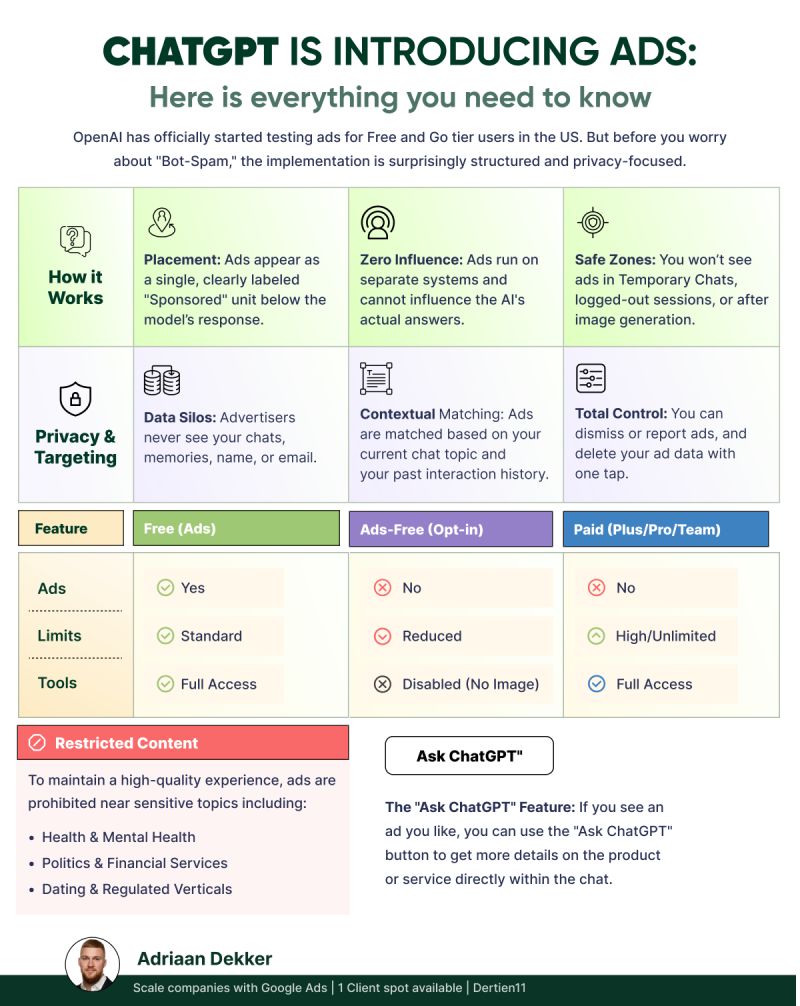
ChatGPT ads are essentially a contextual, in-chat placement model.
But instead of optimising around audiences, cookies, or user profiles, it optimises around conversation context and intent.
It’s built on four layers:
Delivery & placement
↳ Ads appear as a single, clearly labelled “Sponsored” unit
↳ Always placed below the model’s answer
↳ Ads run on separate systems and cannot influence the AI response itself
Privacy & data boundaries
↳ Advertisers never see chats, memories, names or emails
↳ No access to personal conversation data
↳ Matching happens without exposing user-level information
Contextual matching engine
↳ Ads are matched to the current chat topic
↳ Past interaction history is used only at a high level to improve relevance
↳ No behavioural retargeting in the classic ad-tech sense
Control & safety layer
↳ Ads are blocked in sensitive areas (health, mental health, politics, finance, dating and regulated verticals)
↳ No ads in temporary chats, logged-out sessions or after image generation
↳ Users can dismiss, report and delete ad data directly
ChatGPT ads don’t remove performance marketing principles.
They change where relevance, control, and optimisation actually happen.