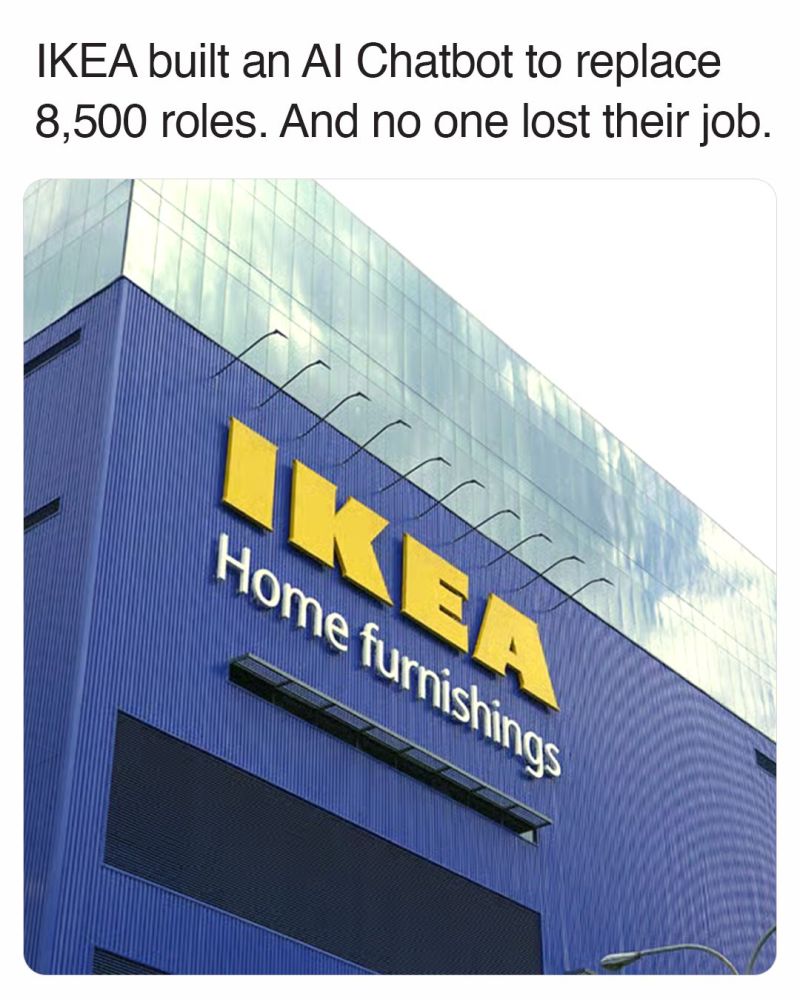
When AI took over routine customer enquiries, IKEA chose to reskill 8,500 employees rather than make them redundant.
That decision changed the story from cost-cutting to growth.
IKEA introduced Billie, a chatbot designed to handle repetitive questions about deliveries, returns, stock availability and opening times.
By 2023, it was handling 47% of customer enquiries directed to call centres.
The conventional response might have been to reduce headcount.
Instead, IKEA retrained and redeployed 8,500 employees into higher-value customer-facing and remote-selling roles, including interior-design support.
The chatbot handled the predictable questions.
People handled the conversations that required judgment, empathy, creativity and expertise.
The result was a remote-sales operation that generated €1.3 billion in revenue in one financial year.
That is the real opportunity with AI.
Not just:
“What can we automate?”
But:
“What could our people achieve if repetitive work was no longer in the way?”
The companies that benefit most from AI will not simply use it to cut costs.
They will redesign work.
They will automate tasks, not human potential.
And they will invest the capacity they create into stronger customer relationships, better services and new sources of growth.
AI does not automatically create a better business.
What matters is what leaders choose to do with the time and talent it unlocks.