Google Ads News
API V24

Google Ads API v24 simplifies keyword forecasting and it’s a notable shiftGoogle has updated GenerateKeywordForecastMetrics, moving toward a more focused and consistent forecasting model aligned with actual campaign performance.
What’s new?
Forecasts now align with bidding strategies
Manual CPC / Maximize Clicks → clicks, average CPC, cost
Maximize Conversions → conversions, average CPA, costForecasts no longer include metrics that don’t directly relate to the selected strategy.
Removed metricsImpressionsConversion valueCross-strategy estimates (such as conversions in click-based forecasts)
Simplified request structuregeo_modifiers[] is now geo_target_constants[]
biddable_keywords[] is now keywords[]
Several fields have been removed, including network settings, negative keywords, bid modifiers, and max CPC inputs
Timelinev24 released: April 2026v23 sunset: February 2027.
Gambling

On May 04, 2026, Google Ads will update its Gambling and games policy to allow online gambling advertisements in Alberta, Canada, for entities authorized by the Alberta Gaming, Liquor and Cannabis Commission (AGLC).
Demand Gen Bug

If your Demand Gen ads are stuck “in review”… it’s not just you.Advertisers are reporting 7+ day delays with no policy flags, no warnings, and no clear reason.
What’s weird:
• It’s only impacting Demand Gen• Search & Performance Max reviews are moving normally
• Delays are showing across accounts + industries
Even Ginny Marvin has confirmed it:👉 Google is aware and working on a fix (no ETA yet)
Why this matters:
Demand Gen relies on speed
• Testing creatives
• Iterating fast
• Jumping on trends
A week-long review delay =
• Slower optimization
• Missed timing opportunities
• Broken campaign pacing
If you’re running Demand Gen right now:
• Build in extra lead time
• Don’t rely on rapid testing cycles (for now)
• Have backup campaigns ready
Demand Gen drops

Demand Gen campaigns on YouTube are outperforming typical paid media, delivering 18% more conversions from new customers.
Two new updates aim to boost results further:
Commerce Media Suite integration: Advertisers can now use retailers’ first-party data (like product catalogs and conversions) to target high-intent shoppers across YouTube, Discover, and Gmail directly in Google Ads.
View-through conversion (VTC) optimization: Campaigns can now optimize for conversions that happen after someone views (but doesn’t click) a YouTube ad, helping drive more conversions faster.
YouTube will be a major focus at Google Marketing Live, where more Demand Gen innovations will be announced.
Bottom line: These updates make Demand Gen campaigns more powerful for acquiring new customers and improving conversion performance especially on YouTube.
Image to animation

Google is rolling out new updates ahead of Marketing Live, including an “Image to Animation” tool. This feature uses AI to turn static images (like product photos or banners) into short, 4-second animated clips without sound.
It’s a simpler version of the existing “create video from images” tool. Unlike full video creation, it only produces single-scene animations, but these can be used in Performance Max (PMax) campaigns or as building blocks for multi-scene videos in Video Builder.
While it’s not a major breakthrough, it offers a quick and low-cost way to create basic video content useful as an alternative to automatically generated PMax videos.
The feature isn’t widely available yet but is expected to roll out more broadly in the coming months.
Thanks for sharing Dario Zannoni
Sponsored stores

Google is now showing sponsored ads in the “Sponsored stores” section within product details on the Google Shopping tab, expanding ads beyond the top-of-page placements and into areas that were previously more free-listing focused.
Spotted by Brodie Clark and covered by Barry Schwartz, the change suggests Google is continuing to blend paid placements deeper into Shopping experiences.
ChatGPT Ads

ChatGPT is starting to show ads to logged-out users a small change with big implications.
By expanding beyond signed-in users, OpenAI is increasing ad inventory and making it easier for advertisers to scale spend.
Until now, limited reach has been a key constraint despite strong demand and lower entry costs.
Ads are integrated directly into chat responses (not banners), and early feedback suggests they’re clearly labeled and relatively unobtrusive.
Display Ads

Google has introduced a new feature in Demand Gen campaigns that allows advertisers to upload static display ads for placement on the Google Display Network.
Advertisers can upload up to 20 images in standard display sizes (like 300×250 or 120×600) using formats such as GIF, JPG, or PNG.
These ads will run exclusively on the Display Network. The feature is already available in some accounts when GDN is selected as a distribution channel.
This update expands Demand Gen capabilities, bringing it closer to traditional Display campaigns by supporting more creative formats.
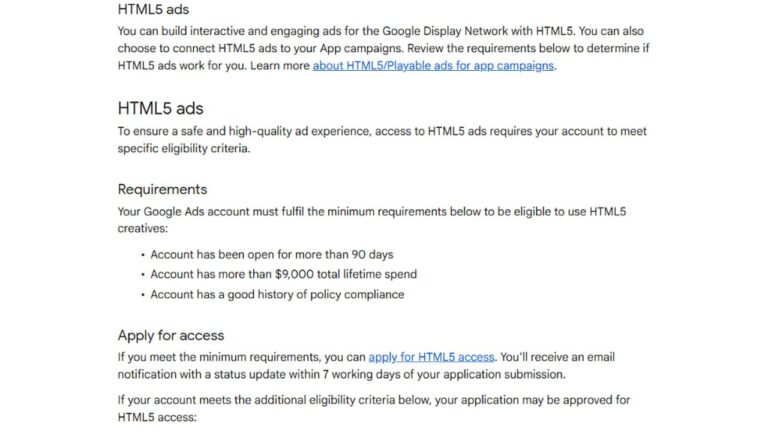
However, it’s unlikely to replace classic Display campaigns yet, since Demand Gen still lacks key features like placement controls, HTML5 creatives, and feed-based ads.
Thanks for sharing Dario Zannoni
API V24

Google has released v24 of the Google Ads API, introducing new features focused on improving conversion tracking.
The headline addition is support for conversions with cart data, which allows advertisers to access deeper insights such as average cart size and revenue per transaction.
To take advantage of these updates, advertisers need to upgrade their client libraries and adapt their code accordingly.
Google is also hosting a live walkthrough event (April 23 at 10 AM ET) to guide users through implementation and new capabilities.
Overall, this release aims to give advertisers more detailed performance metrics and better visibility into purchase behavior.
Ads advisor

Google is adding three new AI-powered safety features to Ads Advisor to make managing Google Ads accounts faster, safer, and more automated.
The three key updates:Proactive troubleshooting: Automatically detects policy violations, explains the issue, and guides (or confirms) fixes before appeals
24/7 security monitoring: Continuously scans accounts, flags risks (like inactive users or suspicious domains), and provides a security dashboard with recommendations
Instant certifications: Replaces manual paperwork by automatically issuing or assisting with required certifications based on your business type and location
These features aim to reduce manual work, improve account security, and keep campaigns running smoothly using AI (powered by Gemini).
AW Tag

Google is phasing out the old “AW-XXXXXXXX” tag format and replacing it with a unified “GT-XXXXXXXX” tagging system across platforms like Google Ads, GA4, and Floodlight.
The goal is to standardize tracking across Google’s ecosystem, which should:- Reduce tag conflicts- Improve data flow between platforms- Deliver more consistent attribution and reporting.
This also introduces features like combining multiple Google tags into a single setup, simplifying configuration.The update was shared by Arjun Singh & Hana Kobzová.
Ad scheduling

Google is changing how daily budget pacing works when ad schedules are used, starting June 1, 2026.
The key point is that spend may fluctuate more from day to day depending on when ads are scheduled to run, rather than being evenly distributed daily.
However, overall billing limits are not changing advertisers will still be capped at 30.4× their daily budget per month.
This update builds on a similar rollout from earlier in 2026 that initially applied to a smaller group of advertisers. It was highlighted by Anthony Higman.
PMAX placement test

Just got this from Renaldo Spin looks like an alpha/beta test for partner selection inside Performance Max 👀If this is rolling out more widely, it could be a pretty big shift.
One of the biggest limitations of PMax has always been the lack of control over where ads show.
Being able to influence (or even select) placements would open up a lot more strategic possibilities.
Still early days, but definitely something to keep an eye on.Anyone else seeing this in their accounts yet?
Consent update

Google Ads launched “App Consent Insights”, a new diagnostics tool that helps you evaluate how well your app’s Consent Mode is working.
What it shows:
– A Consent Rating (Excellent / Good / Poor)
– Number of apps sending consented data
– Consent rates for ads, split between EEA and non-EEA users- Breakdown by app, platform, source, and region
Why it matters:If your EEA consent rate isn’t 100%, you may lose modeled conversions and weaken bidding signalsBetter consent setup = cleaner data + stronger Smart Bidding performance
Key takeaway:Advertisers who optimize consent early (reach “Excellent”) gain a data and performance advantage.
Thanks for sharing Thomas Eccel
Influencer marketing

Google Ads just made influencer marketing a whole lot easier.
The YouTube Creator Partnerships overview now shows you creators who already mention your brand no more manual prospecting.
And the best part? You can promote their sponsored content directly inside Google Ads.
No back-and-forth, no third-party tools.
Credit: Thomas Eccel
Google Introduces AI-Qualified Call Leads

Google has introduced AI-qualified call leads in Google Ads, enhancing how call campaign performance is measured.
Instead of relying mainly on call duration, the system now uses AI to assess the quality of calls and identify valuable leads.
The feature filters out low-value interactions such as spam and robocalls, allowing advertisers to focus on more meaningful conversions. It also improves automated bidding by feeding higher-quality data into optimization models.
Additionally, advertisers gain more transparency through AI-generated call summaries and tagging in reports.
Call recording will be enabled by default for most users so AI can evaluate conversations, though exceptions apply to certain industries like healthcare and financial services. Advertisers can still adjust call duration thresholds or disable recording through account settings.
At launch, the feature is limited to calls within the United States and Canada.
Credit: Hana Kobzová, who first spotted the update.
ChatGPT Ads interface

ChatGPT has started testing CPC (cost-per-click) ads for some advertisers, allowing campaign goals like Reach or Clicks and setting a max CPC bid of $3–$5.
Credit to Juozas Kaziukėnas & Glenn Gabe for sharing the initial screenshots!
New CTA

Arpan Banerjee discovered that YouTube is testing a new CTA!
Experiment

Thomas Eccel discovered that lift studies have moved to the experiment page.