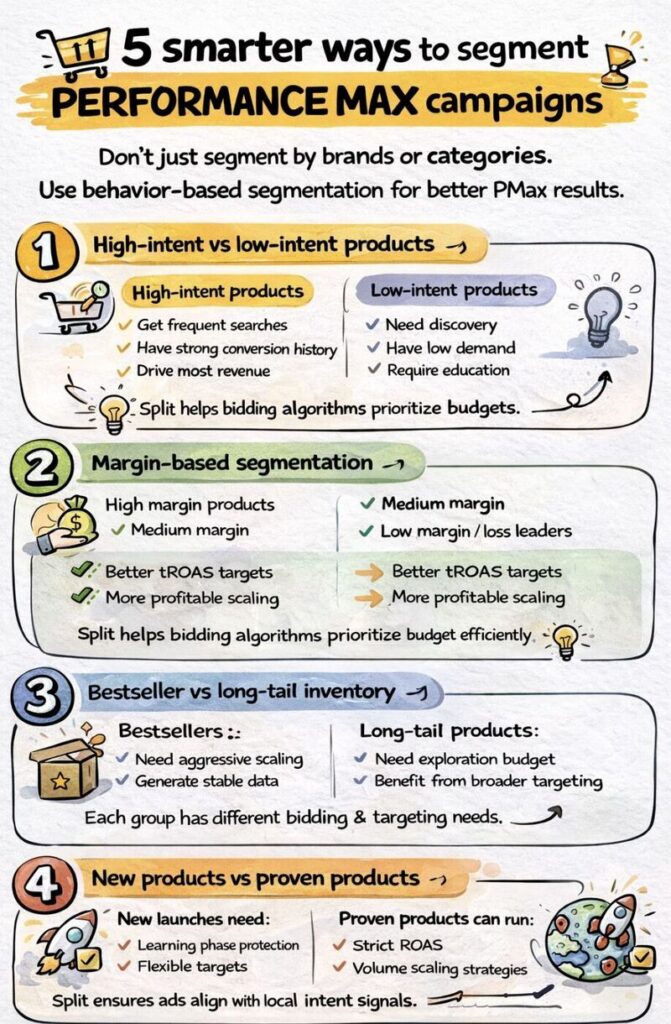
I often see PMax campaigns structured like this:
• One campaign for all products
• Or segmentation only by brand or category
• Or random asset group splits
But Performance Max doesn’t optimize around structure.
It optimizes around signals and behavior.
That’s why smarter advertisers segment based on how products actually perform.
Here are 5 high-impact ways to structure PMax campaigns 👇
🛒 High-intent vs low-intent products
Products with strong search demand and conversion history should not compete for budget with discovery products.
💰 Margin-based segmentation
Revenue ≠ profit.
Splitting campaigns by margin allows better ROAS targets and more profitable scaling.
📦 Bestseller vs long-tail inventory
Top sellers generate stable signals.
Long-tail products need exploration and broader targeting.
🚀 New products vs proven products
New launches need flexible targets and learning protection.
Proven products can run strict scaling strategies.
🌍 Market or behavioral differences
Intent, pricing sensitivity and competition vary by region.
Segmentation helps align bidding with real demand signals.
⚠️ Important disclaimer
Segmentation improves performance only when campaigns have enough data.
Over-segmentation can:
❌ Fragment signals
❌ Slow down learning
❌ Reduce budget efficiency
❌ Create unstable performance
A simple rule:
👉 Segment based on meaningful business differences
👉 Not based on arbitrary structure